MEPHIBOSHETH: FROM LO-DEBAR TO THE KING’S TABLE — THE POWER OF COVENANT GRACE
Key Scriptures: 2 Samuel 9:1–13; 2 Samuel 4:4; 2 Samuel 19:24–30; Ephesians 2:4–7.
Introduction: When Grace Remembers Your Name
There are people whose circumstances have reduced their expectations of life. They have become accustomed to rejection, limitation, disappointment, and obscurity. Their past has shaped their identity, and their present condition has convinced them that certain opportunities are no longer possible.
But the story of Mephibosheth introduces us to a remarkable dimension of God’s grace: sometimes, what changes your life is not what you have achieved, but the covenant through which someone remembers you.
In 2 Samuel 9, we encounter a man who had every reason to believe that his best days were behind him. He was physically disabled, lived away from the royal establishment, and belonged to the family of a former king whose throne had been taken by David.
Yet, in an extraordinary turn of events, the king began asking whether anyone remained from the house of Saul to whom he could demonstrate kindness.
Mephibosheth was about to discover that there was still a place for him at the king’s table.
His story is more than a historical account of royal kindness. It reveals powerful lessons about covenant, grace, humility, restoration, identity, and the unexpected ways in which God can change a person’s circumstances.
1. A Prince Who Lost His Position
Mephibosheth was the son of Jonathan and the grandson of King Saul (2 Samuel 4:4).
He was born into royalty. His family occupied the throne of Israel, and his father, Jonathan, was closely connected to David through a covenant of friendship and loyalty (1 Samuel 18:1–4; 20:12–17).
However, everything changed when news came that Saul and Jonathan had died in battle.
At five years old, Mephibosheth was carried away by his nurse. During the escape, he fell and became lame in both feet (2 Samuel 4:4).
Consider the tragedy of this moment.
A young boy who had been born into a royal family suddenly lost his grandfather, his father, his family’s political position, and his physical ability.
His circumstances changed without his consent.
He did not choose the battle that killed his family. He did not choose the accident that affected his feet. He did not choose the political transition that removed his family from power.
Yet he had to live with the consequences.
This is one of the realities of life: sometimes, people experience consequences of events they never initiated.
A person’s present condition does not always reveal the choices that brought them there.
Your history may explain your condition, but it does not have to become the final definition of your identity.
2. Lo-Debar: Living Outside the Palace
When David eventually searched for someone from Saul’s household, Mephibosheth was living in a place called Lo-debar (2 Samuel 9:4).
Lo-debar is commonly understood as a place name associated with the idea of pasturelessness, although the precise etymological meaning is debated.
What matters in the narrative is that Mephibosheth was living away from the royal environment.
He had royal ancestry, but he was not enjoying royal privileges.
He belonged to a family that once occupied the throne, but he was living far from the palace.
There is a powerful contrast here: his background spoke of royalty, but his circumstances spoke of limitation.
This is an important spiritual lesson.
There can be a difference between what you were connected to and what you are currently experiencing. A person may have great potential, yet live through seasons that do not reflect that potential.
However, we must be careful not to assume that every difficult place is evidence of spiritual failure or that every believer must experience material elevation.
Mephibosheth’s story is specifically about David’s covenant faithfulness and the kindness that followed from it.
His location did not cancel his identity as Jonathan’s son.
And his circumstances did not erase the covenant that David remembered.
Being outside the palace did not mean he had been erased from the king’s consideration.
3. The King’s Question: Is There Anyone Left?
One of the most significant moments in this story is found in 2 Samuel 9:1.
David asked:
“Is there yet any that is left of the house of Saul, that I may shew him kindness for Jonathan’s sake?”
Notice something important about this question.
David was not looking for someone to punish. He was looking for someone to favour.
In the ancient political environment, a new king might eliminate surviving members of a former royal household to prevent possible challenges to his throne. David’s question, therefore, carries considerable significance.
He was deliberately choosing covenant kindness over political hostility.
But why?
Because David remembered Jonathan.
Years earlier, David and Jonathan had entered into a covenant relationship. Jonathan had asked David to show kindness to his household even after the Lord had removed David’s enemies (1 Samuel 20:14–17).
Now that David was established as king, he was honouring that covenant.
This reveals something profound about the nature of covenant.
A covenant can establish obligations that extend beyond the immediate moment in which it was made.
David’s kindness was not based on Mephibosheth’s achievements, influence, or ability to repay him.
It was rooted in a relationship Mephibosheth had not personally established.
Mephibosheth was about to benefit from a covenant that existed before he entered the room.
This provides a beautiful devotional picture of grace. In the Gospel, our hope is not ultimately established by our achievements but by God’s gracious initiative through Jesus Christ (Ephesians 2:4–9).
4. The Unexpected Invitation: Mephibosheth Before the King
When Mephibosheth was brought before David, he bowed himself in reverence.
David addressed him by name:
“Mephibosheth.” (2 Samuel 9:6)
Imagine this encounter.
A man living far from the palace suddenly receives a royal summons. He is brought into the presence of the very king whose throne his grandfather once occupied.
He had every reason to be uncertain about what awaited him.
David, however, immediately reassured him:
“Fear not: for I will surely shew thee kindness for Jonathan thy father’s sake…” (2 Samuel 9:7).
The king was not bringing him into the palace to condemn him.
He was bringing him into the palace to demonstrate kindness.
This is a beautiful picture of unexpected grace.
Mephibosheth did not arrive with a proposal. He did not negotiate his way into the king’s favour. He did not present a record of accomplishments.
He was summoned.
There are moments in Scripture when the initiative belongs entirely to the one showing kindness.
The shepherd seeks the lost sheep (Luke 15:4–7). The father welcomes the returning son (Luke 15:20–24). Christ comes to seek and save the lost (Luke 19:10).
The Gospel begins with God’s initiative, not humanity’s ability to earn salvation.
5. “What Is Thy Servant, That Thou Shouldest Look Upon Such a Dead Dog as I Am?”
This is the central expression of Mephibosheth’s response.
2 Samuel 9:8 records:
“And he bowed himself, and said, What is thy servant, that thou shouldest look upon such a dead dog as I am?”
Why would a man from a royal family describe himself in such a manner?
His statement communicates profound humility and a sense of unworthiness before the king.
He understood his circumstances. He knew his physical limitations. He knew his family’s political history. He probably never imagined that the new king would extend such kindness to him.
The language of a “dead dog” was an expression of extreme lowliness in that cultural setting.
Yet, there is something worth observing: Mephibosheth was looking at himself through the lens of his condition, while David was looking at him through the lens of his covenant with Jonathan.
Mephibosheth saw his limitations.
David remembered his father.
Mephibosheth saw a man who had little to offer.
David saw someone to whom he had a responsibility to demonstrate kindness.
This contrast is remarkable.
Sometimes, the way we understand ourselves is shaped by our painful experiences. We become so familiar with our limitations that we struggle to imagine a different future.
But grace does not operate according to the same measurements as human merit.
The value of what God offers is not determined by how impressive we consider ourselves to be.
Nevertheless, humility should not become a permanent declaration of worthlessness. Mephibosheth’s response expressed his astonishment; it should not be turned into a doctrine that believers must despise themselves.
In Christ, humility and dignity can coexist.
Grace does not require you to pretend you have no weaknesses; it reminds you that your weaknesses do not determine the limits of God’s mercy.
6. Restoration: Everything Changes at the King’s Table
David’s kindness was not merely verbal.
He made practical arrangements for Mephibosheth’s restoration.
In 2 Samuel 9:7, David promised to restore all the land that had belonged to Saul and assured him that he would eat bread continually at the king’s table.
Furthermore, David instructed Ziba and his household to cultivate the land and provide for Mephibosheth’s family (2 Samuel 9:9–10).
Consider the dimensions of this restoration.
First, there was the restoration of inheritance. Mephibosheth was given back the land associated with his grandfather’s household.
Second, there was the restoration of provision. He would no longer depend entirely on the uncertainty of his circumstances.
Third, there was the restoration of relationship. He would have a permanent place at the king’s table.
Fourth, there was the restoration of dignity. He was no longer merely a forgotten descendant of a former king. He was a man publicly received and honoured by the reigning king.
This is where the story becomes especially powerful.
David did not simply send Mephibosheth financial assistance. He brought him into a relationship of royal fellowship.
There is a difference between receiving something from the king and being welcomed to the king’s table.
One speaks of provision. The other speaks of belonging.
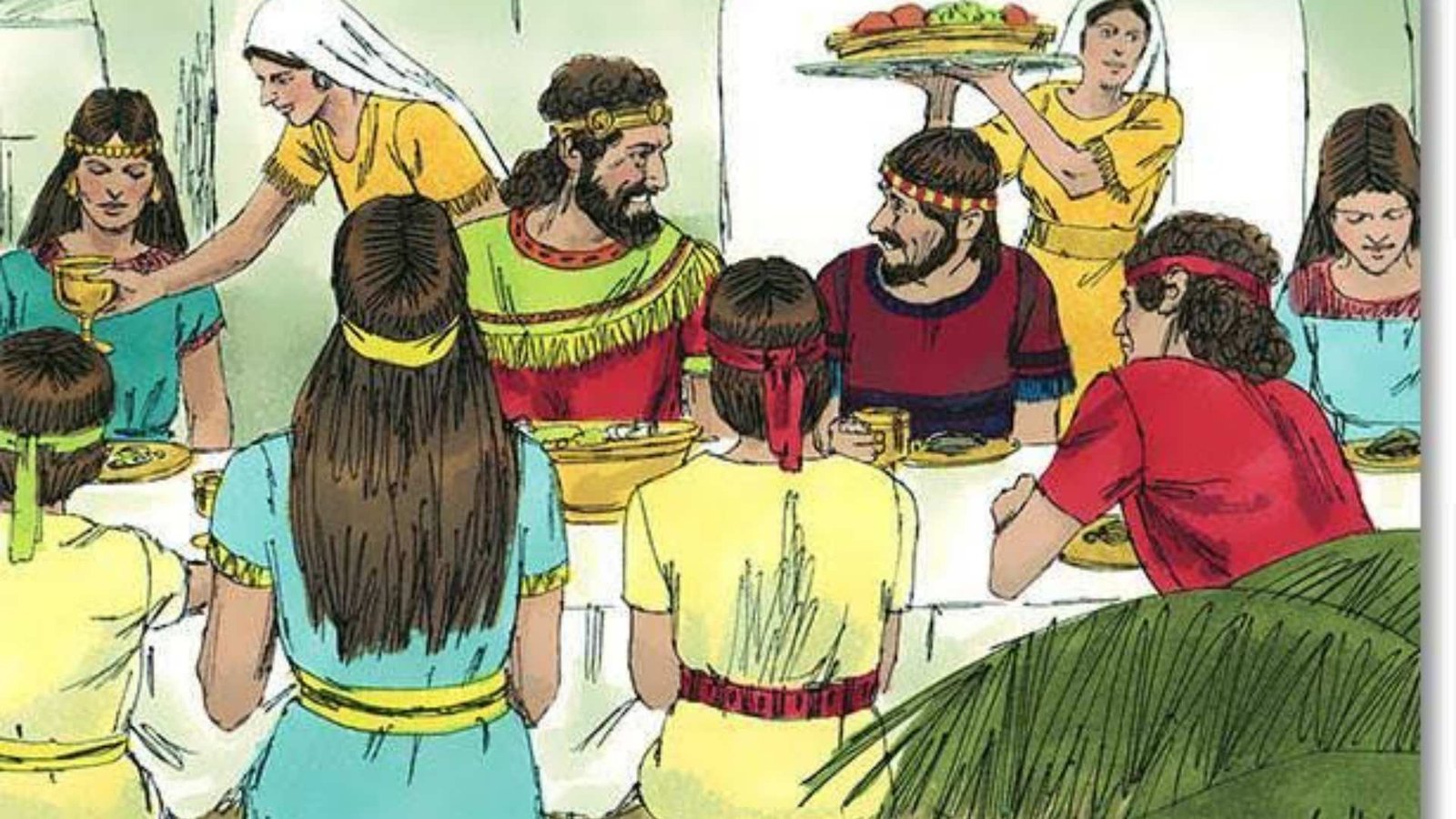
The table became a visible expression of David’s covenant kindness.
7. The King’s Table: A Place Beyond His Limitations
2 Samuel 9:13 tells us that Mephibosheth lived in Jerusalem and ate continually at the king’s table.
The same verse reminds us that he was lame in both feet.
Why does the writer mention his disability again?
Perhaps to ensure that we understand that David’s kindness did not depend on Mephibosheth becoming physically whole.
His condition remained, but his circumstances had changed dramatically.
He was still lame, yet he had a place at the king’s table.
This is an important distinction.
Restoration does not always mean that every physical limitation disappears. Sometimes, God provides grace, dignity, relationships, opportunities, and strength even while certain challenges remain.
The Gospel does not promise believers a life without suffering or physical limitations. It promises reconciliation with God through Christ and the hope of resurrection and final restoration (Romans 8:18–25).
Mephibosheth’s story therefore teaches us not to measure the presence of grace solely by the disappearance of our difficulties.
The greatest evidence of kindness was not that Mephibosheth’s feet had become whole, but that his place at the table was secure.
8. The Greater Picture: Mephibosheth and the Grace of Jesus Christ
The story of Mephibosheth provides a meaningful picture through which we can reflect on the Gospel.
We must distinguish the historical narrative from its devotional application. David’s covenant with Jonathan is not identical to God’s covenant of salvation through Christ. Nevertheless, the story illustrates themes that help us appreciate grace.
Consider these parallels.
David remembered a covenant and demonstrated kindness to someone who had not earned it.
God, in His mercy, provides salvation through Jesus Christ, not as a reward for human achievement but as a gift of grace (Ephesians 2:8–9).
Mephibosheth was brought into the king’s presence.
Through Jesus Christ, those who were once separated from God are brought near (Ephesians 2:13).
Mephibosheth received a place at the king’s table.
In Christ, believers are welcomed into the household of God and given a new identity as His children (John 1:12; Ephesians 2:19).
The Gospel is not simply about improving our earthly circumstances. It is about reconciliation with God, forgiveness of sins, new life in Christ, and the hope of eternal fellowship with Him.
The greatest expression of grace is not merely being moved from a difficult location to a comfortable one. It is being brought from spiritual separation into a relationship with God.
Conclusion: Never Underestimate the Power of Covenant Kindness
Mephibosheth’s story began with loss, but it did not end in obscurity.
He lost his father, experienced a tragic accident, and lived away from the royal establishment. Yet years later, the kindness of David changed the direction of his life.
His story reminds us that circumstances are not always permanent, that human limitations do not erase human dignity, and that genuine covenant relationships carry responsibilities beyond convenience.
It also challenges us to become people who remember kindness, honour commitments, and extend compassion to those who cannot repay us.
David had the power to use his throne for self-preservation alone. Instead, he used his position to honour a covenant and restore another man’s dignity.
That is a lesson for leadership, business, ministry, relationships, and everyday Christian living.
Do not allow your position to make you forget the people who helped you along the way. Do not use your influence merely to protect your interests. When God gives you the opportunity to demonstrate kindness, let your influence become a channel of grace.
And perhaps the most beautiful lesson of all is this:
Mephibosheth arrived at the palace wondering why the king would look upon someone like him. He left knowing that he had a permanent place at the king’s table.
The story of grace is not ultimately about what the undeserving can achieve. It is about what a merciful king chooses to give.
Prayer
Heavenly Father, thank You for Your mercy, kindness, and faithfulness. Teach me to understand the depth of Your grace through Jesus Christ. Help me not to define my life by past disappointments, present limitations, or circumstances beyond my control. Give me a humble heart that recognises Your goodness and a generous spirit that extends kindness to others. May I never forget those who have helped me, and may the influence You have given me become a blessing to those around me. In Jesus’ name, Amen.
Scriptures for Further Study
- 1 Samuel 18:1–4 — The covenant between David and Jonathan.
- 1 Samuel 20:12–17 — Jonathan’s request concerning his household.
- 2 Samuel 4:4 — The tragedy in Mephibosheth’s childhood.
- 2 Samuel 9:1–13 — David demonstrates kindness to Mephibosheth.
- 2 Samuel 19:24–30 — Mephibosheth’s loyalty and David’s judgment.
- Ephesians 2:1–10 — Salvation by grace through faith.
- Ephesians 2:11–22 — Brought near through Christ.
- Romans 8:18–25 — The hope of final restoration.