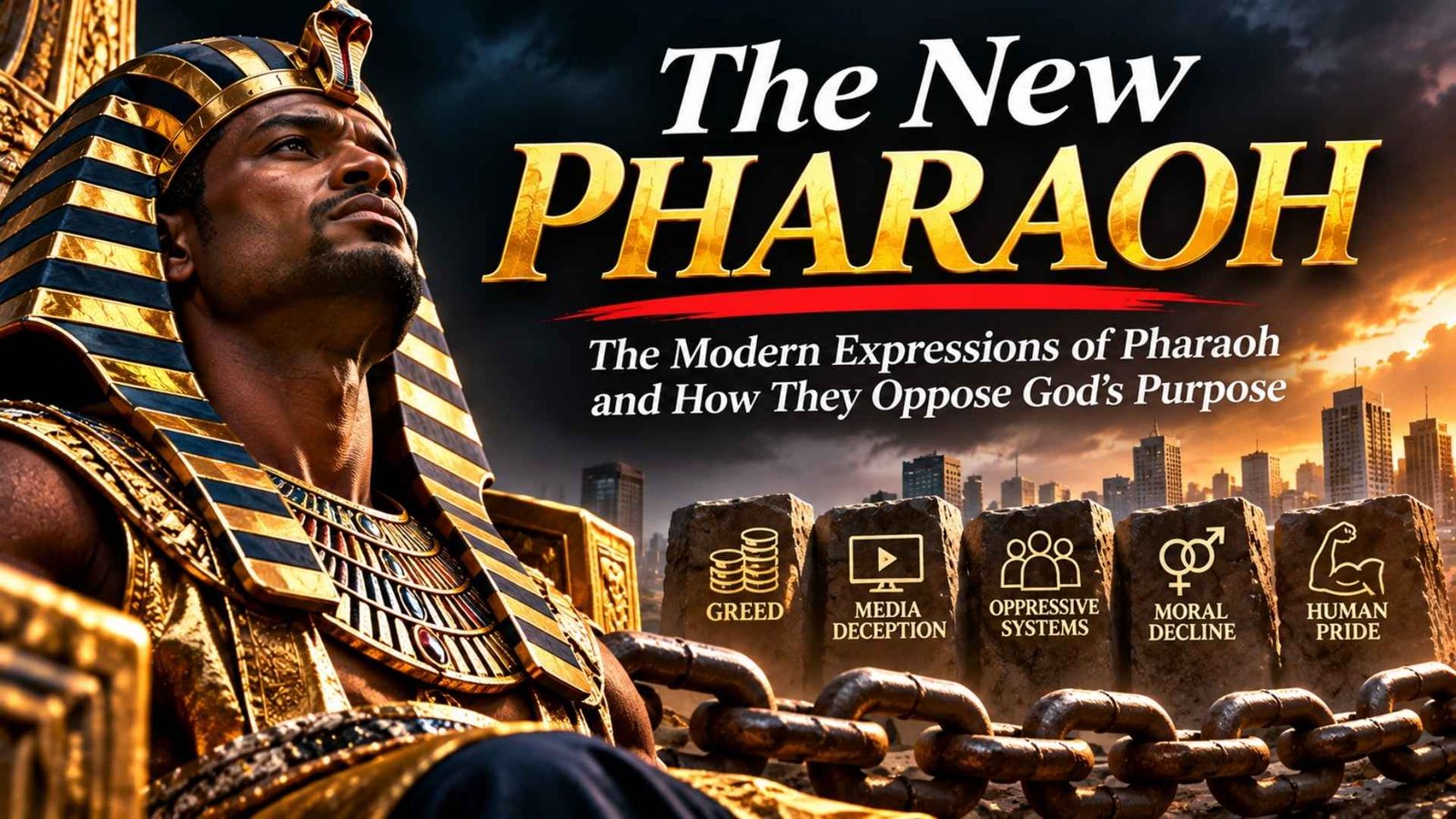
THE NEW PHARAOH
The Emergence of Modern Pharaohs: Oppressive Systems, Hidden Bondage, Human Pride and the Resistance Against God’s Purpose
Key Scriptures
- Exodus 1:8–14 — A new Pharaoh who did not know Joseph.
- Exodus 5:1–9 — Pharaoh’s resistance to God’s command.
- Ecclesiastes 1:9 — There is nothing new under the sun.
- Ephesians 6:12 — The spiritual forces of darkness.
- Revelation 18:1–8 — The judgment of Babylon.
- John 8:36 — The freedom that comes through Christ.
Introduction: A New Pharaoh Has Arisen
One of the most significant statements in the book of Exodus is found in Exodus 1:8:
“Now there arose up a new king over Egypt, which knew not Joseph.”
This statement introduces a new chapter in the history of Israel. The generation that remembered Joseph had passed, and a new Pharaoh had emerged. This king did not recognise the contributions Joseph had made to Egypt. He did not consider the relationship between Joseph’s family and the nation. Instead, he viewed the growing population of Israel as a threat.
His response was to introduce a system of oppression.
What followed was a gradual transformation of the relationship between Egypt and Israel. A people who had once enjoyed favour became a people subjected to forced labour, affliction and persecution.
The expression a new Pharaoh therefore introduces an important biblical subject: the emergence of new authorities, systems and structures that resist God’s purposes and seek to exercise control over people.
But is Pharaoh merely an ancient Egyptian king whose story belongs to history?
Or does his story reveal patterns of human behaviour and oppressive systems that can reappear in different generations?
Throughout Scripture, we encounter rulers, institutions and systems that oppose righteousness, exploit people, promote idolatry and resist the purposes of God.
The names may change. The methods may change. The environment may change. But the patterns of pride, oppression, deception and rebellion can remain remarkably familiar.
Pharaoh may disappear from the throne, but the spirit of oppression can find expression in another generation.
This article examines the biblical pattern of Pharaoh and its relevance to the modern world.
1. The New Pharaoh: When a New Generation Forgets History
Exodus 1:8 is remarkable because it does not simply introduce a new king. It introduces a change in the nation’s attitude towards a people who had previously been received favourably.
Joseph had become instrumental in preserving Egypt during a severe famine (Genesis 41–47). His wisdom and leadership helped establish Egypt’s position during a period of crisis.
Yet the new Pharaoh did not recognise Joseph’s legacy.
Exodus 1:9–10 records Pharaoh’s concern that the Israelites had become numerous and might become a threat during a future conflict.
His solution was oppression.
This reveals an important characteristic of oppressive leadership: it can reinterpret the presence of a group of people as a threat in order to justify controlling them.
The Israelites were no longer viewed through the contribution of Joseph but through Pharaoh’s fear.
There is a lesson for modern societies and institutions.
When leadership is built on fear, suspicion and the desire to maintain control, people can become victims of policies that disregard their dignity and contributions.
History also teaches us that progress is not automatically permanent. A generation may enjoy freedom, stability and opportunity, while another generation may introduce policies that threaten those achievements.
We must therefore remain vigilant about the values upon which societies and institutions are built.
2. The New Pharaoh Does Not Always Wear a Crown
When we think about Pharaoh, we naturally imagine an Egyptian king sitting on a throne.
But the biblical narrative reveals that Pharaoh’s influence was expressed through more than his personal authority.
He controlled systems.
He had taskmasters, officers, labour arrangements and structures that enforced his decisions.
Exodus 1:11 tells us that taskmasters were appointed over the Israelites to afflict them with burdens.
Exodus 5 further reveals how the labour system was manipulated to increase their suffering.
This is important because oppressive influence can operate through individuals, institutions, policies and organised structures.
In contemporary society, a modern expression of Pharaoh may be found wherever power is deliberately used to exploit, intimidate, manipulate or suppress people.
This can happen in governments, workplaces, religious institutions, businesses and even families.
A leader who uses fear to control employees, a system that exploits vulnerable people, or an institution that punishes people for speaking against wrongdoing may display characteristics associated with Pharaoh’s oppressive administration.
However, we must distinguish between biblical symbolism and direct biblical teaching. Scripture does not call every oppressive institution Pharaoh, nor does it establish that every difficult authority is controlled by a demonic spirit.
The connection is an application of the principles revealed in Exodus.
The throne may belong to one person, but the oppression can be sustained by an entire system.
3. The New Pharaoh Seeks to Control Worship and Allegiance
The confrontation between Moses and Pharaoh was fundamentally about authority and worship.
God instructed Moses to say:
“Let my people go, that they may serve me.” (Exodus 8:1)
Pharaoh’s resistance was therefore not simply a disagreement over labour. It was a refusal to acknowledge God’s authority over the people he was oppressing.
This is one of the most significant dimensions of the Pharaoh narrative.
Pharaoh wanted Israel to remain under his authority, while God called Israel into covenant relationship with Him.
The conflict revealed competing claims over allegiance.
In the modern world, the same principle can be observed whenever human authority demands the kind of devotion, obedience or submission that belongs to God alone.
For example, a leader may demand that employees compromise their integrity to preserve their positions. A religious leader may manipulate followers into believing that questioning the leader is equivalent to questioning God. A political system may demand unquestioning loyalty even when its policies contradict righteousness.
Acts 5:29 gives an important principle:
“We ought to obey God rather than men.”
Human authority has legitimate boundaries. No earthly authority has the right to occupy God’s position in the conscience of a believer.
The Christian must respect legitimate authority while maintaining ultimate allegiance to God.
4. The New Pharaoh Uses Fear to Maintain Control
One of Pharaoh’s greatest concerns was the growth of Israel.
Exodus 1:9–10 reveals his fear that the Israelites might become too numerous and potentially align themselves with Egypt’s enemies.
His response was to increase their oppression.
This reveals how fear can become an instrument of control.
When people are constantly made to feel threatened, they may become easier to manipulate. When uncertainty is deliberately created, people may surrender freedoms in exchange for temporary security.
The same principle can operate in modern institutions and relationships.
Fear of losing employment may cause someone to tolerate exploitation. Fear of rejection may cause a person to remain in an unhealthy relationship. Fear of spiritual punishment may cause people to submit to manipulative religious leadership.
Second Timothy 1:7 reminds believers that God has not given us the spirit of fear, but of power, love and a sound mind.
Christian faith does not mean ignoring legitimate dangers. It means refusing to allow fear to become the master of our decisions.
A system that must constantly manufacture fear to preserve its authority deserves careful examination.
5. The New Pharaoh Understands the Power of Labour Without Freedom
Exodus 1:13–14 describes how the Egyptians made the Israelites serve with rigour.
Their lives became bitter through hard bondage.
One of the striking aspects of Pharaoh’s system was that Israel’s labour benefited Egypt while the Israelites themselves remained oppressed.
They were productive, but they were not free.
This provides a useful lens for examining modern exploitation.
People can be economically productive while experiencing injustice. Workers can generate considerable value while being denied fair treatment. Communities can contribute to national development while remaining neglected.
The biblical principle is that human beings must not be reduced to instruments for another person’s enrichment.
Leviticus 19:13 warns against oppressing one’s neighbour or robbing them.
James 5:4 condemns the withholding of wages from labourers.
These passages demonstrate that God is concerned about economic justice and the treatment of workers.
Business owners, employers and leaders must therefore recognise that authority comes with responsibility.
Profit should never become an excuse for exploitation.
A system that benefits from people’s labour while deliberately denying their dignity reflects the injustice we see in Pharaoh’s Egypt.
6. The New Pharaoh Resists the Deliverance of Others
When Moses first approached Pharaoh, the king did not simply refuse to release Israel. He increased their workload.
Exodus 5:6–9 records Pharaoh’s instruction that the Israelites should no longer receive straw for making bricks, yet their production target would remain unchanged.
This was a calculated response to the demand for freedom.
Rather than reconsidering his oppression, Pharaoh made their situation more difficult.
This is a familiar pattern in oppressive systems.
Sometimes, when people begin to question injustice, the system responds by increasing pressure.
Those who seek reform may face intimidation. Those who expose corruption may experience retaliation. Those who seek independence may be threatened with the loss of privileges or opportunities.
However, the biblical narrative also teaches us that resistance does not mean that God’s purpose has failed.
Moses experienced discouragement after Pharaoh’s response (Exodus 5:22–23). Yet God reaffirmed His covenant and promised deliverance in Exodus 6:1–8.
This is an important lesson for anyone confronting injustice.
Opposition does not automatically mean that you are on the wrong path. At the same time, every disagreement should not be interpreted as persecution.
Wisdom requires discernment, patience and courage.
7. The New Pharaoh May Offer Freedom With Conditions
In the previous article, The Charm of Pharaoh, we examined the different compromises Pharaoh proposed to Moses.
He suggested that Israel could worship within Egypt, leave without going too far, send only the men, or depart without their possessions.
These negotiations reveal an important feature of oppressive control: the desire to retain influence even when complete control becomes difficult.
Modern systems can also offer forms of conditional freedom.
A person may be permitted to speak, provided they never challenge certain interests. Employees may be allowed to advance, provided they compromise their integrity. Religious people may be permitted to practise their faith, provided they never question the demands of those exercising control.
The lesson is not that every condition is oppressive. Legitimate institutions require reasonable rules and responsibilities.
The danger arises when conditions are deliberately designed to preserve injustice or prevent people from exercising legitimate freedom.
Galatians 5:1 reminds Christians to stand firm in the freedom Christ has given.
We must be careful not to exchange the freedom of conscience and obedience to God for the temporary comfort of human approval.
8. The New Pharaoh and the Modern Babylonian System
Another biblical account worth considering is the imagery of Babylon.
In Revelation 17–18, Babylon is portrayed as a powerful and corrupt system associated with idolatry, luxury, deception, exploitation and opposition to God’s people.
Revelation 18:3 describes the influence of Babylon’s corruption among the nations, while Revelation 18:11–13 describes the commercial wealth and trade associated with the system.
There are similarities between the oppressive patterns of Egypt under Pharaoh and the corrupt system represented by Babylon.
Both narratives reveal the dangers of power that becomes detached from righteousness.
Egypt under Pharaoh exploited human labour and resisted God’s command.
Babylon represents a corrupt order built around idolatry, excessive luxury and exploitation.
However, we must not confuse the two biblical accounts. Pharaoh is an individual ruler in the Exodus narrative, while Babylon in Revelation functions as a complex prophetic image of worldly corruption and opposition to God.
Their significance is not that every modern government or economic institution is literally Babylon or Pharaoh.
Rather, they help believers recognise recurring patterns of injustice, pride, exploitation and idolatry.
9. Christ Is Greater Than Every Pharaoh
The story of Exodus is ultimately a story of deliverance.
Pharaoh resisted, negotiated, threatened and pursued Israel, but he could not overturn God’s covenant purpose.
God demonstrated His sovereignty through the plagues, the Passover and the crossing of the Red Sea.
For Christians, the greater foundation of freedom is found in Jesus Christ.
Colossians 1:13 declares that God has delivered believers from the power of darkness and translated them into the kingdom of His dear Son.
John 8:36 states:
“If the Son therefore shall make you free, ye shall be free indeed.”
This freedom is first and foremost freedom from the dominion of sin through Christ.
It also shapes how Christians respond to injustice, manipulation, exploitation and ungodly authority.
We must not become another Pharaoh while claiming to represent God.
A Christian leader must not manipulate people. A business owner must not exploit workers. A parent must not use authority to destroy a child’s dignity. A minister must not replace the lordship of Christ with personal control.
The answer to Pharaoh is not the emergence of another Pharaoh with a different identity.
The answer is leadership shaped by the character of Christ.
Jesus taught that those who exercise authority among His followers must serve rather than dominate (Mark 10:42–45).
Conclusion: Recognising the Patterns of Pharaoh in Every Generation
The emergence of a new Pharaoh in Exodus reminds us that the values of one generation can be replaced by the ambitions and fears of another.
The Pharaoh who arose after Joseph did not recognise the history of Israel’s contribution. He saw their growth as a threat and established a system of oppression.
His story provides a warning about the dangers of pride, fear, exploitation and the misuse of authority.
In every generation, believers must remain alert to systems and individuals that demand what belongs to God, exploit the vulnerable, manipulate human dignity or resist righteousness.
But our responsibility is not to become suspicious of every authority or label every difficult institution as Pharaoh.
Our responsibility is to uphold truth, practise justice, defend human dignity and remain faithful to God.
The story of Exodus reminds us that no earthly authority is absolute.
Pharaoh had chariots, taskmasters, officers, wealth and a throne. Yet he could not prevent the fulfilment of God’s purpose.
A new Pharaoh may arise in every generation, but no Pharaoh has the authority to overturn the sovereignty of God.
The believer’s confidence is not in the weakness of earthly powers but in the greatness of Jesus Christ.
Prayer
Heavenly Father,
Give me the wisdom to recognise oppression, deception, manipulation and the misuse of authority wherever they appear.
Deliver me from the desire to control others, and help me become a person who exercises influence through righteousness, humility and love.
Strengthen those who are experiencing injustice and give wisdom to those entrusted with leadership.
Help me remain faithful to You even when earthly systems demand compromise.
May my life reflect the character of Christ, and may I never become the kind of person who oppresses others while claiming to serve You.
Thank You because Your authority is greater than every earthly throne.
In Jesus’ mighty name, Amen.
Scriptures for Further Study
- Genesis 41–47 — Joseph’s leadership and the preservation of Egypt.
- Exodus 1:8–22 — The emergence of the new Pharaoh.
- Exodus 3:1–12 — God’s call to Moses.
- Exodus 5:1–23 — Pharaoh increases the burden.
- Exodus 7–12 — God’s judgments upon Egypt.
- Exodus 14:1–31 — The defeat of Pharaoh’s army.
- Psalm 82:1–4 — God’s concern for justice.
- Isaiah 10:1–4 — Unjust laws and oppression.
- Mark 10:42–45 — Leadership through service.
- Acts 5:29 — Obedience to God above human authority.
- Colossians 1:13–14 — Deliverance from the power of darkness.
- Revelation 17–18 — The judgment of Babylon.