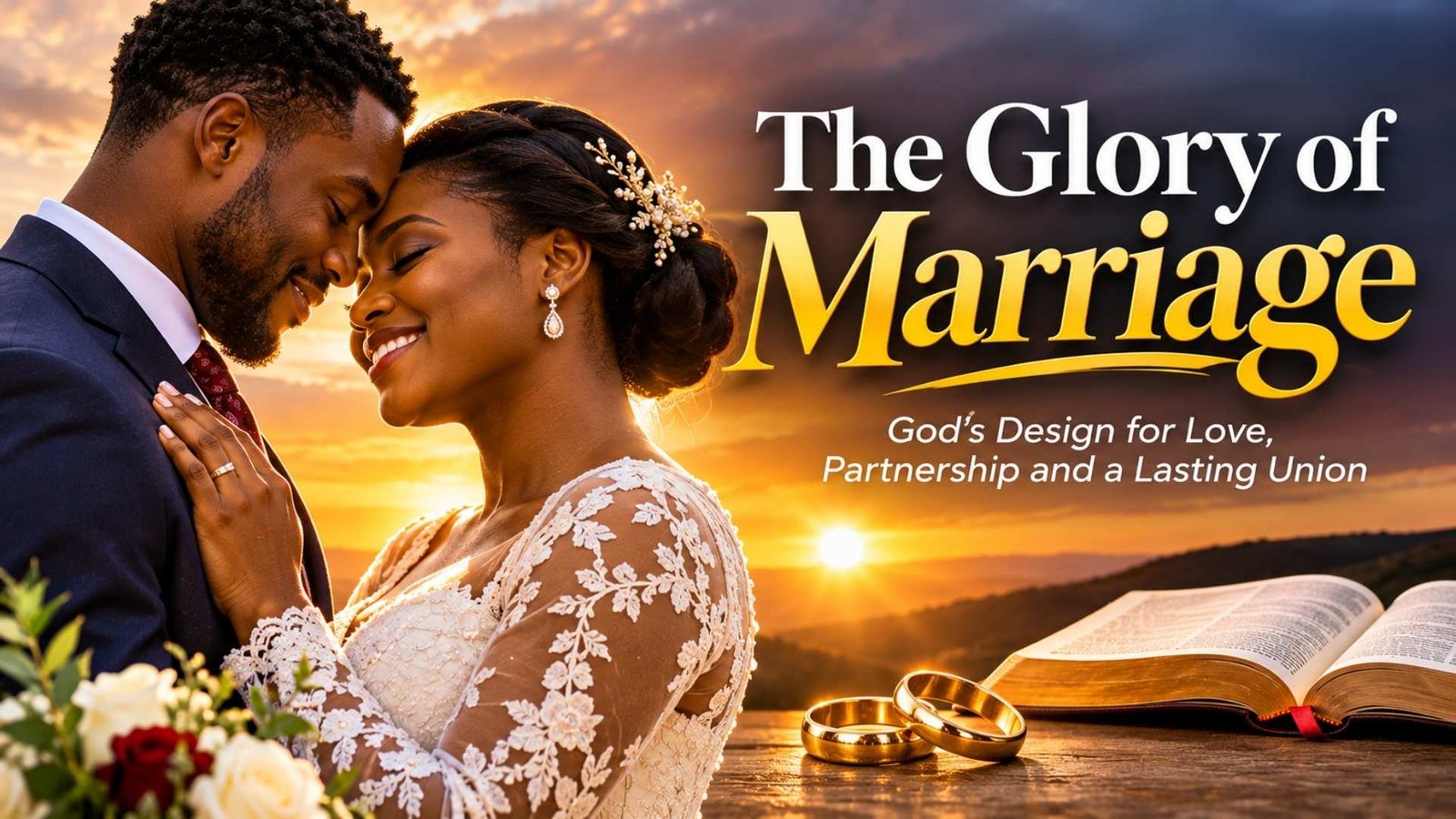
THE GLORY OF MARRIAGE: God’s Design, the Beauty of Covenant and the Mystery of Two Becoming One
Key Scriptures: Genesis 2:18–25; Proverbs 18:22; Ecclesiastes 4:9–12; Ephesians 5:21–33; Hebrews 13:4.
Introduction: Marriage Was God’s Idea
Marriage is one of the most remarkable institutions established by God. Before governments existed, before nations were formed, before economic systems and human institutions developed, God established marriage.
Its origin was not in human culture but in divine intention.
In Genesis 2, we encounter the creation of man, the formation of woman and the establishment of the first marriage. It is a beautiful account that reveals something significant about God’s understanding of companionship, relationship and human responsibility.
Marriage was not introduced merely because humanity needed someone to share expenses, build a home or raise children. It was established as a covenant relationship in which two people become one and share life before God.
Yet, the glory of marriage is often misunderstood. Some see it primarily as romance. Others regard it as a social achievement, while some measure its success by financial stability, children or outward appearance.
These things may form part of the experience of marriage, but they do not fully explain its significance.
Marriage carries a deeper spiritual meaning. It involves companionship, sacrifice, commitment, intimacy, responsibility and the demonstration of love through everyday living.
Marriage is more than finding someone to share your life with; it is accepting the responsibility of building a life together under God’s design.
1. Marriage Originated in God’s Intention
Genesis 2:18 records one of the first declarations concerning marriage:
“And the LORD God said, It is not good that the man should be alone; I will make him an help meet for him.”
This statement is significant because it is the first occasion in the creation narrative where something is described as not good.
Everything created previously had been declared good. Yet, when God considered man’s solitary condition, He identified something that required attention.
God declared that it was not good for man to be alone.
This does not mean that every human being must marry to experience a complete or meaningful life. Jesus Himself lived without marrying, and Paul explains that singleness can be a valuable calling (1 Corinthians 7).
Rather, the passage establishes God’s provision of marriage as a good gift and a suitable form of companionship for humanity.
God then formed the woman and brought her to the man (Genesis 2:21–22).
Notice something remarkable: the woman was not presented as an afterthought. She was deliberately formed and brought into the relationship.
Marriage, therefore, begins with God’s design, not merely human attraction.
Attraction may introduce two people, but a godly marriage requires much more than attraction to sustain it.
2. The Glory of Marriage Is Found in Oneness
Genesis 2:24 declares:
“Therefore shall a man leave his father and his mother, and shall cleave unto his wife: and they shall be one flesh.”
This is one of the foundational scriptures concerning marriage.
Three important ideas appear in this verse: leaving, cleaving and becoming one flesh.
Leaving establishes a new family relationship. Marriage creates a new primary household responsibility. Parents remain important, but the husband and wife must establish their own family unit.
Cleaving speaks of attachment, commitment and faithfulness. Marriage is not designed to be a temporary arrangement that survives only when circumstances are favourable.
One flesh describes the union of husband and wife. It includes physical intimacy, but its significance extends to the shared life, commitment and identity of the married couple.
This is why marriage requires more than two people occupying the same house.
Two people can share a bedroom without sharing understanding. They can share finances without sharing vision. They can raise children without cultivating emotional intimacy.
The biblical idea of oneness calls couples towards a deeper unity.
It does not mean that individual personalities disappear or that one person loses their identity. Rather, two distinct individuals learn to build a shared life through love, mutual respect and commitment.
The beauty of marriage is not that two people become identical, but that two different lives become united in covenant.
3. Marriage Reveals the Beauty of Complementarity
In Genesis 2:18, God describes the woman as a helper suitable for the man.
The Hebrew expression translated as help meet carries the idea of a corresponding or suitable helper.
It should not be understood as suggesting that the woman is inferior to the man.
Indeed, Scripture frequently uses the language of help to describe God’s own assistance to His people (Psalm 121:1–2).
The woman was created as a corresponding companion, someone suitable to share the human assignment.
This is important because marriage is not a competition for superiority.
A husband and wife bring different experiences, perspectives, strengths and abilities into the relationship.
One may be more analytical, the other more emotionally expressive. One may be skilled in financial planning, while the other may have particular strengths in communication or organisation.
These differences can become sources of strength when managed with humility.
However, complementarity should never be used to justify disrespect, oppression or the denial of a spouse’s gifts.
The biblical picture is not one person being valuable while the other merely exists to serve them.
Both are created in God’s image (Genesis 1:27), and both deserve dignity.
Marriage becomes stronger when each person recognises the value of the other.
4. The Glory of Marriage Is Revealed Through Covenant Love
There is a difference between attraction and commitment.
Attraction is often influenced by appearance, personality, emotion and shared interests. Commitment involves a deliberate decision to remain faithful and responsible within the relationship.
Marriage brings these dimensions together, but covenant provides its foundation.
Malachi 2:14 describes marriage as a covenant relationship.
This is significant because covenant is more substantial than a casual agreement.
An agreement can be approached primarily through the question of what each person receives. Covenant introduces the deeper responsibility of faithfulness.
This does not mean marriage should tolerate abuse, violence or destructive behaviour. Commitment must never be used to silence someone experiencing harm or to prevent necessary protection and intervention.
Rather, covenant reminds us that marriage is not designed to operate on selfish convenience.
There will be seasons when feelings fluctuate, circumstances change and responsibilities become demanding.
During such seasons, love must be expressed through patience, honesty, forgiveness, service and consistency.
First Corinthians 13:4–7 provides a beautiful description of love.
Love is patient and kind. It does not insist on its own way, is not easily provoked and rejoices in truth.
These qualities are not merely poetic descriptions for wedding ceremonies. They are practical standards for everyday married life.
The glory of marriage is not demonstrated only on the wedding day. It is revealed in the thousands of decisions made afterwards.
5. Marriage Reflects the Relationship Between Christ and the Church
Perhaps the most profound biblical explanation of marriage is found in Ephesians 5:21–33.
Paul uses the relationship between husband and wife to illustrate the relationship between Christ and the Church.
He begins by addressing mutual submission out of reverence for Christ (Ephesians 5:21).
He then instructs wives concerning their relationship with their husbands and calls husbands to love their wives as Christ loved the Church.
This is a remarkable standard.
Christ’s love for the Church is not selfish, exploitative or controlling. He gave Himself for her.
Consequently, the husband is not presented with a licence to dominate his wife. He is given a demanding responsibility to love sacrificially.
Paul also calls husbands to nourish and cherish their wives as their own bodies.
The passage concludes by returning to the Genesis principle of two becoming one flesh.
The mystery of marriage is therefore connected to the Gospel.
The relationship between husband and wife becomes an illustration of Christ’s faithful, self-giving love for His people.
However, marriage is not identical to the relationship between Christ and the Church. Christ is the Saviour; a human spouse is not.
The analogy points us towards the character of Christ and the kind of love marriage should reflect.
The glory of a Christian marriage is not found in how much authority one spouse exercises, but in how faithfully both reflect the character of Christ.
6. Marriage Is a Partnership of Purpose and Responsibility
Ecclesiastes 4:9–10 declares:
“Two are better than one; because they have a good reward for their labour. For if they fall, the one will lift up his fellow.”
Although this passage speaks broadly about the value of companionship, it offers a meaningful principle for marriage.
Marriage is a partnership.
Two people come together with the opportunity to share responsibilities, support one another and build something that would be difficult to accomplish alone.
This partnership extends into several areas of life.
Financial responsibility: Couples must learn to discuss money, establish priorities, manage resources and make decisions that protect their household.
Emotional responsibility: Marriage requires the ability to listen, understand, encourage and create an environment where both partners feel valued.
Spiritual responsibility: Couples can pray together, study Scripture, encourage one another’s faith and establish a home where Christ is honoured.
Family responsibility: Where children are present, both parents share important responsibilities in nurturing, teaching and providing for them.
But partnership does not mean that everything must always be divided equally in every circumstance. Different seasons may require different contributions.
One spouse may carry more responsibility during a period of illness, financial difficulty or professional transition.
What matters is the willingness to work together rather than approach marriage as a competition over who contributes more.
A successful marriage is not built by two people keeping score. It is built by two people taking responsibility.
7. The Glory of Marriage Is Tested in Ordinary Moments
Many people imagine marriage through its beautiful moments: weddings, anniversaries, romantic holidays, celebrations and family photographs.
These moments are valuable, but they do not represent the entirety of married life.
Much of marriage happens in ordinary circumstances.
It happens when one spouse is tired after work. It happens when bills must be paid, when decisions must be made and when disagreements arise.
It happens when one person must apologise, when forgiveness is required and when both must choose patience over anger.
Colossians 3:12–14 encourages believers to put on compassion, kindness, humility, meekness, patience and forgiveness.
These instructions are particularly relevant to marriage.
A spouse should not have to live in an environment where every mistake becomes an opportunity for humiliation.
Neither should marriage become a place where silence, resentment and unresolved disagreements accumulate.
Communication is essential.
Couples must learn to discuss difficult matters without destroying one another through their words.
They must understand that winning an argument is not necessarily the same as strengthening a relationship.
There are moments when the wisest thing a husband or wife can do is listen.
There are moments when an apology is more valuable than an explanation.
There are moments when forgiveness becomes the beginning of restoration.
The strength of marriage is often revealed not in how couples celebrate together, but in how they navigate difficult moments together.
8. Marriage Is a Garden That Requires Cultivation
Consider the Garden of Eden.
In Genesis 2:15, God placed Adam in the garden to dress it and keep it.
The garden was beautiful, but it still required responsibility.
This provides an interesting principle when considering marriage.
Marriage is a gift, but it also requires cultivation.
A relationship should not be abandoned to assumption. Love must be expressed, communication maintained and trust protected.
A husband cannot assume that because he once demonstrated affection, his wife will forever feel valued without continued attention.
A wife cannot assume that because a marriage began with excitement, emotional intimacy will automatically remain strong.
Relationships require intentional investment.
This includes spending quality time together, appreciating one another, maintaining healthy boundaries with outsiders and protecting the privacy and dignity of the relationship.
It also includes developing individually.
A healthy marriage does not require two people to stop growing. Rather, it creates an environment where both can mature while continuing to build together.
The garden of marriage must be watered with patience, protected by faithfulness and cultivated through daily acts of love.
9. The Glory of Marriage Is Not the Absence of Challenges
It is important to correct a common misconception: a godly marriage is not necessarily a marriage without difficulties.
Even sincere Christian couples experience disagreements, financial pressures, disappointments, misunderstandings and seasons of emotional difficulty.
The presence of challenges does not automatically mean that a marriage is outside God’s will.
What matters is how those challenges are addressed.
Ephesians 4:26–27 teaches believers to deal responsibly with anger rather than allowing it to become an opportunity for sin.
James 1:19 encourages believers to be swift to hear, slow to speak and slow to anger.
These principles remind couples that character matters.
There must be room for honest conversations, repentance, forgiveness and growth.
Where serious difficulties arise, seeking wise pastoral guidance and professional marriage counselling can be helpful.
Where abuse or violence exists, safety and appropriate protection must take priority. Biblical commitment should never be used to demand that someone remain exposed to harm.
Marriage is sacred, but the dignity and safety of the people within it matter deeply.
10. The Glory of Marriage Is Not the Only Expression of a Fulfilled Life
There is one final perspective worth considering.
While marriage is a beautiful gift, Scripture does not teach that every person must marry to fulfil God’s purpose.
Jesus was unmarried. Paul also discusses the value of singleness in 1 Corinthians 7.
This is important because marriage should never become an idol or a measure of spiritual superiority.
A married person is not automatically more fulfilled than an unmarried person.
Neither is an unmarried person incomplete.
Marriage is one of God’s good provisions for human companionship, but our ultimate completeness and identity are found in Christ.
When marriage is understood correctly, it becomes a place where two people honour God together rather than attempt to make one another the source of ultimate fulfilment.
A spouse can provide companionship, encouragement and support, but only God can occupy the place that belongs to Him.
This understanding protects marriage from unrealistic expectations.
Your spouse is human. Your spouse will have weaknesses, limitations and areas of growth.
The beauty of marriage is learning to love and honour one another while both remain dependent on God’s grace.
Conclusion: Marriage Is a Gift, a Covenant and a Responsibility
The glory of marriage begins with God’s intention in creation and finds its deeper spiritual significance in the relationship between Christ and the Church.
It is a union of companionship, covenant, intimacy, responsibility and shared purpose.
It requires more than attraction to begin and more than emotion to sustain.
It requires two people who are willing to build, forgive, sacrifice, communicate and grow together.
Genesis reveals the beauty of two becoming one flesh. Ephesians reveals the sacrificial character of love. Ecclesiastes reminds us of the strength found in companionship.
Together, these scriptures present marriage as something far greater than a social arrangement.
It is a relationship that provides an opportunity to demonstrate godly love in practical and visible ways.
Remember:
A wedding establishes a marriage, but daily commitment cultivates it.
Love may bring two people together, but faithfulness helps them build a life together.
The glory of marriage is not simply found in having someone beside you, but in learning to honour God through the life you build together.
May our marriages become places where love is expressed, dignity is protected, faith is strengthened and the character of Christ is reflected.
A Prayer for Marriages
Heavenly Father, thank You for the gift and institution of marriage. Teach husbands and wives to understand the beauty of covenant and the responsibility of loving one another.
Give couples wisdom to navigate difficult seasons, humility to admit their mistakes, grace to forgive and strength to remain faithful.
May our homes become places of peace, mutual respect, understanding and spiritual growth. Help us to reflect the sacrificial love of Christ in our relationships.
For those preparing for marriage, grant wisdom and discernment. For those experiencing difficulties, provide strength, appropriate support and direction. For those who are single, remind them that their identity and fulfilment are found in You.
May our relationships honour Your name. In Jesus’ name, Amen.
Scriptures for Further Study: Genesis 1:26–28; Genesis 2:18–25; Proverbs 18:22; Ecclesiastes 4:9–12; Malachi 2:14–16; Matthew 19:4–6; 1 Corinthians 7; Ephesians 5:21–33; Colossians 3:12–19; Hebrews 13:4.