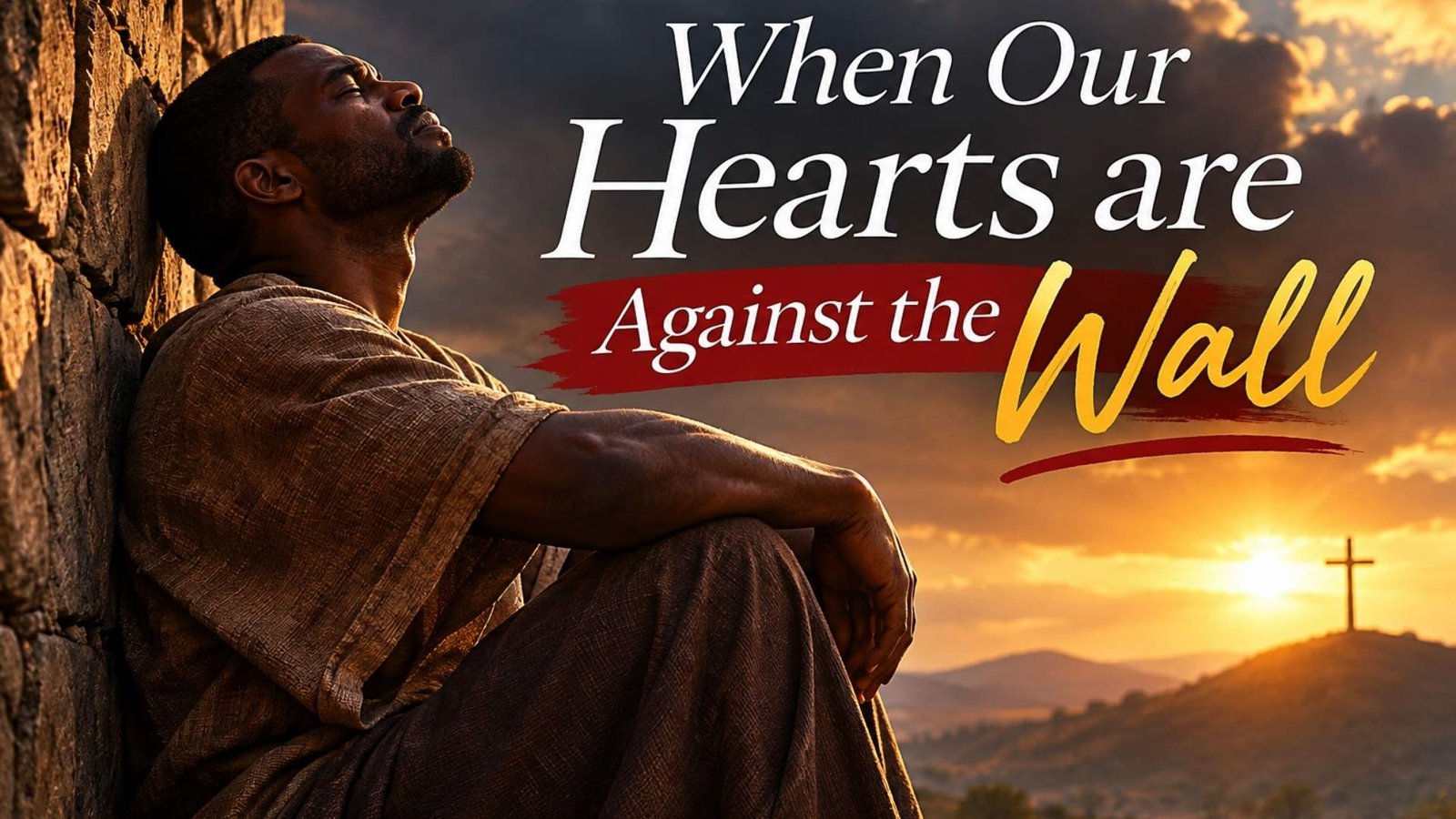
When Our Hearts Are Against the Wall
Finding Faith When Life Leaves Us With No Visible Way Forward
Key Scriptures
-
Exodus 14:10–16 – Israel at the Red Sea.
-
Psalm 46:1–3 – God, our refuge and strength.
-
2 Chronicles 20:12 – “We do not know what to do, but our eyes are upon you.”
-
2 Corinthians 4:8–9 – Pressed but not crushed.
-
Isaiah 43:2 – When you pass through the waters, I will be with you.
Introduction: The Moments When Life Gives Us No Options
There are moments in life when circumstances become so overwhelming that we begin to question everything we once believed. Moments when the things we depended on begin to fail, the people we trusted become unavailable, the doors we expected to open remain shut, and the future we carefully imagined suddenly becomes uncertain.
These are the moments when our hearts are against the wall.
It is one thing to exercise faith when everything is working in our favour. It is another thing to maintain that faith when the evidence around us appears to contradict everything we have believed about God’s faithfulness.
Sometimes, the greatest battle is not necessarily what is happening around us but what begins to happen within us. Fear, anxiety, disappointment, confusion and unanswered questions begin to compete with our confidence in God.
Yet Scripture reveals something remarkable: some of the most significant encounters between God and His people occurred when they found themselves in situations where human possibilities had been exhausted.
Being against the wall does not necessarily mean God has abandoned us. Sometimes, it is the place where our dependence on Him is exposed, our faith is tested, and our understanding of His power is enlarged.
1. Israel at the Red Sea: When There Was Nowhere to Run
One of the most remarkable illustrations of this experience is found in Exodus 14.
After years of slavery in Egypt, the children of Israel had finally been delivered. Pharaoh had released them, and they were on their journey towards the land God had promised their fathers.
But their journey suddenly encountered an unexpected obstacle.
Before them was the Red Sea. Behind them was Pharaoh’s army, advancing with chariots and horses.
They were caught between an overwhelming body of water and an approaching military force.
Humanly speaking, there was no reasonable escape.
Exodus 14:10 records that when the Israelites saw the Egyptians approaching, they became terrified and cried out to the Lord.
Interestingly, their reaction was not entirely surprising. They had witnessed God’s mighty acts in Egypt, yet the immediate threat before them overwhelmed their confidence.
This teaches us an important lesson about human nature: previous testimonies do not automatically eliminate present fears.
A person can have experienced God’s faithfulness yesterday and still struggle with anxiety about tomorrow.
The Israelites had witnessed the plagues, the Passover and their miraculous departure from Egypt. Yet, at the Red Sea, they questioned whether leaving Egypt had been a mistake.
Sometimes, the pressure of the present can make us forget the faithfulness of the past.
But the story was not over.
God had not brought them out of Egypt only for Pharaoh to have the final word.
2. The Danger of Allowing Fear to Rewrite Our Testimonies
In Exodus 14:11–12, the Israelites began questioning Moses.
They asked whether there were no graves in Egypt that he had brought them into the wilderness to die.
Their words revealed something deeper than fear. Their present circumstances had begun to distort their understanding of their entire journey.
They were now interpreting their deliverance through the lens of their immediate difficulty.
This is one of the dangers of difficult seasons.
When disappointment becomes overwhelming, we can begin to reinterpret our past, question our decisions and even doubt the things God has previously established in our lives.
We begin to say:
Perhaps I should never have started that business.
Perhaps I should never have taken that step.
Perhaps I misunderstood God’s direction.
Perhaps things were better when I had not attempted anything.
Not every difficult situation means we made the wrong decision. Sometimes, a right decision can lead us into an uncomfortable season.
However, this does not mean we should refuse correction or ignore wisdom. We must remain willing to examine our decisions honestly while refusing to let fear become the interpreter of our lives.
Fear has a way of making yesterday’s bondage look more attractive than tomorrow’s freedom.
Israel had forgotten the pain of Egypt because the pressure of the wilderness had become immediate.
We must be careful not to romanticise the places God has already brought us out of simply because the next stage is difficult.
3. When You Do Not Know What to Do
One of the most powerful statements in Scripture is found in the prayer of King Jehoshaphat.
In 2 Chronicles 20, Judah was confronted by a great military threat. Several nations had gathered against them, and the king recognised that his army was facing an enemy beyond its apparent capacity.
He responded by seeking the Lord and proclaiming a fast throughout Judah.
His prayer contained a remarkable confession:
“We have no might against this great company that cometh against us; neither know we what to do: but our eyes are upon thee.” — 2 Chronicles 20:12 (KJV).
Consider the honesty of that prayer.
Jehoshaphat did not pretend to have a solution. He did not manufacture confidence or present himself as a king who had everything under control.
He admitted his limitations.
He acknowledged the magnitude of the challenge and confessed that he did not know what to do.
But he added something significant: Our eyes are upon You.
This is the posture of faith.
Faith does not mean we always know what to do. It means that even when we do not know what to do, we know where to turn.
There is spiritual maturity in recognising the limits of our understanding without surrendering our confidence in God.
Sometimes, our greatest act of faith is not making another move but learning to wait before God for wisdom.
James 1:5 reminds believers that anyone who lacks wisdom should ask God, who gives generously.
You do not have to pretend to know everything. You can bring your confusion before God.
4. When God Says, Move Forward
Returning to the Red Sea, something interesting happens.
After Moses encouraged the Israelites to stand firm and see the salvation of the Lord, God gave him another instruction.
Exodus 14:15 records:
“Wherefore criest thou unto me? speak unto the children of Israel, that they go forward.”
This is remarkable.
The people were standing before an impossible obstacle, yet God’s instruction was to move forward.
The instruction did not mean that the sea was already open. It meant that their next step was to be taken in obedience to God’s direction.
Moses stretched out his hand over the sea, and God caused the waters to divide.
The Israelites crossed on dry ground.
There is a lesson here that we must understand carefully.
Faith is not reckless movement. It is not an excuse to ignore circumstances, abandon responsibility or make irrational decisions.
Rather, biblical faith responds to God’s direction even when the outcome is not yet visible.
Sometimes, we want God to reveal the entire journey before we take the next step.
But often, He gives us sufficient direction for the step immediately before us.
You may not understand the entire business journey, but you can take the next responsible step.
You may not know how every family challenge will be resolved, but you can choose wisdom, patience and love today.
You may not see how a difficult season will end, but you can remain faithful to God in the present.
The absence of a visible pathway does not mean there is no pathway ahead.
5. The Wall Does Not Always Mean the Same Thing
We must also understand that not every difficult situation is a Red Sea experience.
Sometimes, the wall before us is the consequence of our own decisions.
Sometimes, it is the result of circumstances beyond our control.
Sometimes, it is opposition from others.
Sometimes, it is simply the reality of living in a fallen world where suffering, disappointment and uncertainty exist.
The Bible does not teach that every hardship is caused by the devil or that every difficult situation will be resolved through an immediate miracle.
Joseph experienced betrayal and imprisonment before his elevation (Genesis 37–50).
Job experienced devastating losses without Scripture presenting his suffering as a direct consequence of personal wrongdoing.
Paul experienced imprisonment, persecution and physical hardship despite his faithfulness to Christ (2 Corinthians 11:23–28).
These accounts remind us that faithfulness to God does not exempt believers from difficult experiences.
What matters is how we respond.
When our hearts are against the wall, we must be willing to pray, examine ourselves, seek wise counsel, make necessary adjustments and remain faithful.
Sometimes God delivers us from a situation. Sometimes He sustains us through it. Sometimes He uses the experience to correct our direction or deepen our maturity.
We must not reduce God’s faithfulness to one particular outcome.
6. Pressed, But Not Crushed
Paul offers another powerful perspective in 2 Corinthians 4:8–9:
“We are troubled on every side, yet not distressed; we are perplexed, but not in despair; persecuted, but not forsaken; cast down, but not destroyed.”
Notice the contrasts.
Paul does not deny the existence of trouble.
He acknowledges that believers can experience pressure, perplexity, persecution and discouragement.
Yet he distinguishes between experiencing hardship and being ultimately defeated by it.
This is an important distinction.
Christian resilience is not pretending that nothing hurts. It is learning that our suffering does not have to become the final definition of our lives.
We can be disappointed without becoming hopeless.
We can be confused without abandoning our faith.
We can experience rejection without concluding that we have no value.
We can encounter financial difficulty without surrendering our integrity.
We can be pressed by circumstances without allowing those circumstances to destroy our relationship with God.
Our confidence is not rooted in our ability to control every situation. It is rooted in the God who sustains us.
7. Jesus Christ: The Hope Beyond Our Difficulties
Ultimately, the Christian understanding of difficult seasons must find its foundation in Jesus Christ.
The cross itself presents the greatest contrast between apparent defeat and God’s redemptive purpose.
At Calvary, the disciples witnessed the arrest, suffering and crucifixion of the One they believed was the promised Messiah.
From their immediate perspective, their hopes appeared to have collapsed.
The One who had healed the sick, raised the dead and spoken with authority was now hanging on a cross.
Yet what appeared to be defeat became central to God’s redemptive work.
Through His death and resurrection, Jesus accomplished what humanity could never accomplish for itself: the provision of salvation and reconciliation with God.
This does not mean every painful situation in our lives will follow the same pattern or result in the earthly outcome we desire.
Rather, the resurrection establishes something far greater: suffering, death and apparent defeat do not have the final authority over those who belong to Christ.
Romans 8:31–39 reminds us that nothing can separate believers from the love of God in Christ Jesus.
That is our ultimate security.
Our hope is not merely that God will remove every wall we encounter. Our hope is that, through Christ, even death itself cannot separate us from Him.
8. Do Not Build Your Permanent Home Against the Wall
There is one more lesson worth considering.
When life becomes difficult, it is easy to become comfortable with a mentality of survival.
We begin to define ourselves by our struggles.
Every decision is influenced by fear. Every opportunity is approached with suspicion. Every disappointment becomes another reason to withdraw.
But difficult seasons should not become our permanent identity.
Israel was not delivered from Egypt to spend the rest of its existence standing before the Red Sea.
There was a journey ahead.
There was a wilderness to navigate, lessons to learn and a promise to pursue.
Likewise, we must not allow one difficult chapter to become the entire story of our lives.
There is a difference between acknowledging a difficult season and surrendering our identity to it.
We can grieve without becoming bitter.
We can wait without becoming passive.
We can acknowledge uncertainty without abandoning responsibility.
We can remain hopeful without pretending that everything is easy.
And above all, we can continue walking with God.
Never allow the wall in front of you to become bigger than the God who walks with you.
Conclusion: When There Is No Way, Keep Your Eyes on God
There will be moments when our hearts are against the wall.
Moments when our strength is insufficient, our understanding is limited and our options appear exhausted.
But the Scriptures remind us that our relationship with God is not dependent on favourable circumstances.
The Israelites discovered that the Red Sea was not the end of their journey.
Jehoshaphat discovered that acknowledging his inability was not the same as surrendering his faith.
Paul discovered that being pressed did not mean being abandoned.
And through Jesus Christ, we have the assurance that God’s love is greater than the suffering and uncertainties of this present life.
Perhaps you are standing before a wall today.
Perhaps you have prayed, planned, tried and exhausted every option you can see.
Do not allow the pressure of the moment to make you forget the faithfulness of God.
Pray when you do not know what to do. Seek wisdom when you are confused. Take responsibility where necessary. Obey when God gives direction. And when the road is unclear, keep your eyes on Him.
The wall may be real, but it is not necessarily the end.
Sometimes, the greatest revelation of God’s faithfulness comes when we discover that our own strength was never sufficient to carry us through.
A Prayer for Those Against the Wall
Heavenly Father,
When our hearts are overwhelmed and our circumstances appear beyond our understanding, help us to keep our eyes upon You.
Give us wisdom where we lack understanding, strength where we feel weak, patience where we must wait and courage where we must move forward.
Forgive us for the moments when fear has made us forget Your faithfulness. Teach us not to interpret our entire lives through the difficulties of a single season.
May our faith remain anchored in Jesus Christ, regardless of what we encounter.
And when we do not know what to do, remind us that we can still look to You.
In Jesus’ name, Amen.
Scriptures for Further Study
-
Exodus 14:1–31
-
Psalm 34:17–19
-
Psalm 46:1–11
-
2 Chronicles 20:1–30
-
Isaiah 43:1–3
-
Romans 8:31–39
-
2 Corinthians 4:7–18
-
Hebrews 13:5–6