
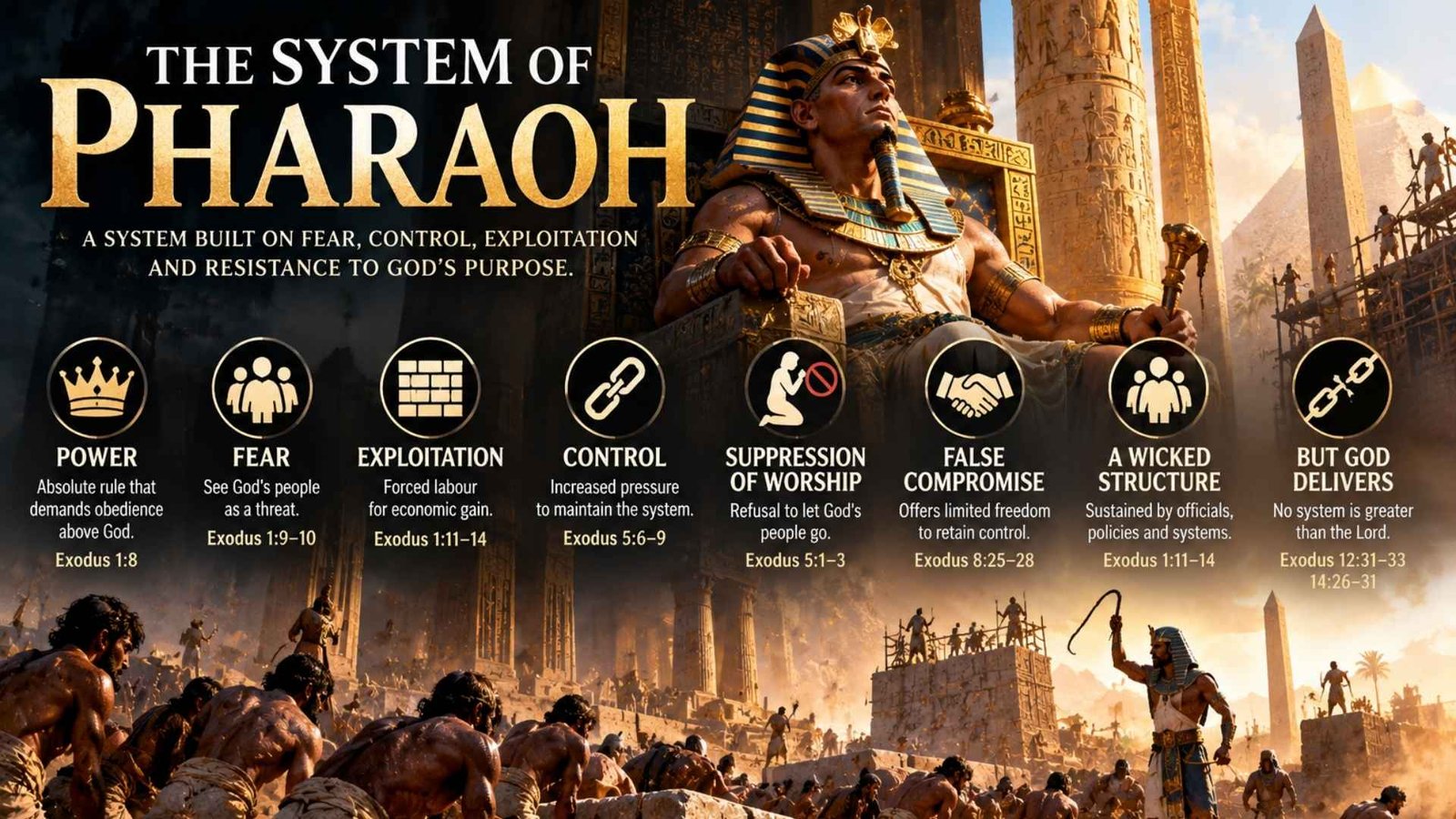
The System of Pharaoh: Understanding the Structures That Oppose God’s Purpose
Key Scriptures
-
Exodus 1:8–14 — Pharaoh’s oppression of the Israelites.
-
Exodus 5:1–9 — Pharaoh’s refusal to release God’s people.
-
Exodus 8:25–28 — Pharaoh’s attempt to negotiate the terms of Israel’s worship.
-
Exodus 12:31–33 — Pharaoh finally releases the Israelites.
-
Romans 12:2 — The call not to conform to the pattern of this world.
Introduction: More Than the Actions of One King
When we read the account of Israel’s deliverance from Egypt, it is easy to focus exclusively on Pharaoh as an individual: a powerful king who refused to obey God and subjected the Israelites to slavery. Yet the narrative reveals something deeper. Pharaoh’s oppression was sustained by an entire system of authority, economic interests, fear, forced labour, and policies designed to preserve Egypt’s power.
Pharaoh was not merely resisting Moses. He was defending an arrangement in which Israel’s labour benefited Egypt, Israel’s growth threatened Egyptian security, and Israel’s worship of God challenged Pharaoh’s authority over their lives.
In this sense, the system of Pharaoh represents a structure of power that seeks to preserve its control even when that control conflicts with God’s purposes.
This concept can help us examine oppressive leadership, exploitative workplaces, unjust institutions, spiritual manipulation, and the personal habits that keep people trapped in bondage. However, we must distinguish between the historical narrative of Exodus and the broader applications we draw from it. Not every difficult authority is Pharaoh, and not every obstacle is an expression of spiritual oppression.
The central question is this: What happens when a system becomes so committed to preserving its power that it refuses to recognise the rights, dignity, and purpose of those under its control?
The book of Exodus provides a compelling answer.
1. The System of Pharaoh Begins with a Change in Perspective
Scripture: Exodus 1:8–10
The account begins with a significant statement: a new king arose over Egypt who did not know Joseph.
Joseph had previously served Egypt faithfully during a severe famine. Through the wisdom God gave him, Egypt preserved food and survived a national crisis. Yet generations later, the relationship between Egypt and Joseph’s people changed.
Exodus 1:9–10 records Pharaoh’s concern that the Israelites had become numerous and might become a threat during a war. His response was to introduce policies intended to control their growth and secure Egypt’s interests.
Notice the progression. Pharaoh first viewed the Israelites through the lens of fear. Their increasing population was no longer seen as an ordinary demographic development but as a political threat.
Fear became the justification for oppression.
This is one of the first characteristics of a destructive system: it begins to interpret people primarily according to the threat they supposedly pose to its interests. Rather than treating them with justice, it begins to regard them as problems to be managed.
In modern society, this pattern may appear when leaders use fear to justify discrimination, employers exploit workers because they believe those workers have no alternatives, or institutions suppress legitimate concerns to protect their reputation.
The lesson is not that every security concern is illegitimate. Governments and organisations have responsibilities to protect people. The danger arises when fear becomes an excuse for denying others their dignity and freedom.
A system becomes dangerous when protecting its interests becomes more important than treating people justly.
2. Pharaoh Converts People into Instruments of Production
Scripture: Exodus 1:11–14
Pharaoh appointed taskmasters over the Israelites and subjected them to hard labour. They built supply cities for Egypt, including Pithom and Rameses. Their lives became bitter under the burden of forced service.
The narrative exposes the economic dimension of Pharaoh’s power.
Egypt benefited from Israel’s labour, while Israel endured the cost. The people were not free to determine the direction of their work or enjoy its fruits as independent people. Their labour served a system that treated their existence as a resource for the kingdom.
This is a defining feature of exploitative systems: people are valued for what they can produce but not necessarily respected for who they are.
The same principle can be seen in contemporary settings where workers are underpaid, employees are denied reasonable rest, or vulnerable people are pressured into accepting unjust conditions because they lack alternatives. Economic productivity is important, but productivity without justice can become exploitation.
The biblical account does not condemn work itself. Scripture consistently affirms diligence, responsibility, and productive labour. The problem in Egypt was that labour had been separated from freedom and justice.
There is a difference between leading people towards productive service and using authority to consume their lives for someone else’s advantage.
For Christian business owners and leaders, this passage raises an important question: Do the people who help build an organisation also experience dignity, fairness, and the opportunity to flourish?
A business may grow financially while failing morally. Pharaoh’s Egypt reminds us that impressive structures can be built upon deeply unjust arrangements.
God is concerned not only with what a system produces, but also with how it treats the people who produce it.
3. Pharaoh Uses Increased Pressure to Preserve Control
Scripture: Exodus 1:12–14; 5:6–9
Exodus 1:12 records a striking development: the more the Egyptians oppressed the Israelites, the more the Israelites multiplied and spread. Pharaoh’s attempt to weaken them did not produce the outcome he desired.
Instead of reconsidering his approach, he intensified their suffering.
Later, when Moses and Aaron delivered God’s command to let Israel go, Pharaoh responded by increasing the workload. He ordered that the Israelites gather their own straw while maintaining the same production quota for bricks (Exodus 5:6–9).
This response reveals the character of Pharaoh’s resistance. When confronted with a demand for freedom, he did not examine the injustice of the existing arrangement. He made the arrangement more difficult to escape.
The pattern is familiar: when people challenge an unjust system, those benefiting from it may respond by increasing pressure, withdrawing privileges, spreading discouragement, or making the cost of resistance appear unbearable.
In Exodus 5, the Israelites initially blamed Moses and Aaron because their situation had become worse. This is an important part of the narrative. The first visible consequence of challenging an established structure was not immediate relief but increased suffering.
It reminds us that the exposure of injustice does not always lead to instant change. Sometimes, the first reaction of a threatened system is to defend itself more aggressively.
However, this passage should not be used to teach that every worsening circumstance proves a person is pursuing God’s will. The biblical lesson is more specific: Pharaoh deliberately increased the burden to discourage the Israelites from responding to God’s command.
Christian discernment requires us to evaluate circumstances through Scripture, wisdom, truth, and godly counsel rather than interpreting every difficulty as confirmation of a particular spiritual theory.
4. Pharaoh Attempts to Control Worship
Scripture: Exodus 5:1–3; 8:25–28
One of the most revealing dimensions of Pharaoh’s system is its resistance to Israel’s worship of God.
Moses’ message was direct: “Let my people go, that they may hold a feast unto me in the wilderness” (Exodus 5:1, KJV).
Pharaoh’s response was equally direct. He asked, “Who is the LORD, that I should obey his voice to let Israel go?” (Exodus 5:2, KJV).
His refusal was not simply a disagreement over labour arrangements. It was also a rejection of the authority of the God who had commanded Israel’s release.
As the plagues unfolded, Pharaoh began proposing compromises. In Exodus 8:25, he offered to let the Israelites sacrifice to God within Egypt. Later, in Exodus 8:28, he agreed to let them go into the wilderness but instructed Moses not to go very far.
These negotiations are significant. Pharaoh was willing to consider limited concessions, but he continued trying to determine the boundaries of Israel’s obedience.
He wanted to accommodate worship without surrendering control.
In the immediate historical context, Israel’s departure involved leaving Egypt to worship the Lord as He commanded. We should not assume that every detail of Pharaoh’s negotiations is a universal formula for identifying spiritual opposition. Nevertheless, the narrative presents a clear conflict between God’s authority and Pharaoh’s determination to retain control.
The broader principle remains relevant. Christian faith cannot be reduced to a private activity that has no influence on a believer’s decisions, values, or conduct. Following Christ affects how we work, how we treat others, how we handle money, and what we are willing to compromise.
An employer, political leader, family member, or institution may have legitimate authority within its sphere. But human authority is not absolute. When obedience to a human demand would require disobedience to God, Christians must recognise the limits of that authority.
Pharaoh wanted to permit worship on his terms; God commanded His people to serve Him according to His word.
5. Pharaoh Offers Partial Freedom Without Relinquishing Authority
Scripture: Exodus 8:25–28; 10:8–11, 24–27
Pharaoh’s negotiations continued as the plagues progressed.
In Exodus 10, he proposed that only the men should go and worship the Lord, leaving the women and children behind. Later, he permitted the people to go but insisted that their livestock remain in Egypt (Exodus 10:8–11, 24).
These proposals were attempts to limit the extent of Israel’s departure. Pharaoh was not offering the complete release God had commanded through Moses. He was trying to retain leverage over the people.
The text does not require us to interpret every proposal as a separate hidden spiritual code. Its central point is already clear: Pharaoh repeatedly resisted the full demand of God.
This offers a useful lesson about freedom and responsibility.
Sometimes, people leave one difficult situation only to remain dependent on the same controlling arrangement in another form. A person may gain a new job but continue operating under fear and manipulation. An organisation may announce reform while retaining the practices that produced injustice. A leader may apologise publicly without changing the behaviour that caused the harm.
Partial change can be meaningful, but it should not be confused with complete transformation.
For Christians, this also raises a personal question: Are there areas in which we desire God’s help while resisting His authority?
We may want peace without forgiveness, influence without integrity, success without discipline, or spiritual growth without repentance. We may ask God to improve our circumstances while refusing to address the attitudes that contribute to our difficulties.
Pharaoh’s resistance is primarily a historical example of hardened opposition to God. Yet it also invites us to examine our own tendency to negotiate with truth when obedience becomes costly.
Freedom is not merely the removal of pressure; it also involves learning to live responsibly under the right authority.
6. The System of Pharaoh Is Sustained by More Than Pharaoh Alone
Scripture: Exodus 1:11–14; 5:6–14
Although Pharaoh stands at the centre of the narrative, the oppression of Israel involved taskmasters, officials, production demands, and established practices. The king’s policies became a structure carried out by many people.
This matters because destructive systems are rarely sustained by one individual alone. They continue when policies, incentives, habits, and institutions repeatedly produce the same outcomes.
A leader may establish an unjust practice, but administrators enforce it. Others benefit from it. Some participate out of fear, while others may regard it as normal because it has existed for so long.
Over time, injustice can become routine.
The biblical account does not suggest that every Egyptian involved had identical motives or responsibility. Rather, it demonstrates how royal authority translated into widespread suffering.
This principle has implications for leadership, government, business, and ministry. When a workplace consistently mistreats employees, changing one manager may not be enough if the policies still reward exploitation. When an institution struggles with corruption, condemning individual offenders is insufficient if its processes continue to encourage dishonesty.
Christian leadership must therefore address both personal character and organisational structures.
Good intentions are not enough if the systems we design repeatedly harm people. Likewise, prayer should not become an excuse for neglecting practical reforms, accountability, sound policies, and responsible management.
A Christ-centred approach to leadership asks not only whether the person in charge is sincere, but also whether the organisation’s practices reflect justice, honesty, stewardship, and care for others.
7. God Hears the Cry of the Oppressed
Scripture: Exodus 2:23–25; 3:7–10
The system of Pharaoh did not have the final word.
Exodus 2:23–25 records that the Israelites groaned under their bondage and cried out to God. The passage says that God heard their groaning, remembered His covenant with Abraham, Isaac, and Jacob, and took notice of them.
In Exodus 3:7–10, God tells Moses that He has seen the affliction of His people, heard their cry, and knows their sorrows. He then commissions Moses to confront Pharaoh and lead Israel out of Egypt.
The language is deeply significant. God is not portrayed as indifferent to the suffering of His people. Their oppression is seen, their cries are heard, and their deliverance becomes the focus of divine action.
God’s response also involves human responsibility. He sends Moses to Pharaoh. The deliverance of Israel unfolds through God’s power, His promises, Moses’ obedience, and the events recorded throughout Exodus.
This gives us a balanced understanding of divine intervention. God is able to act beyond human limitations, but He may also call people to speak truth, confront injustice, serve others, and participate in meaningful change.
For believers facing oppression, the passage offers hope without requiring the claim that every painful circumstance will end immediately. Israel’s deliverance was a specific act in the unfolding biblical story of God’s covenant purposes. Christians can draw encouragement from God’s concern for the oppressed while acknowledging that Scripture does not promise every believer an effortless escape from every unjust situation in this life.
The church, therefore, must do more than speak about deliverance. It should embody compassion, defend the vulnerable, practise integrity, and support just treatment in the communities where God has placed it.
The God who hears the cry of the oppressed also calls His people to become agents of truth, mercy, and justice.
8. The Defeat of Pharaoh Reveals the Limits of Human Power
Scripture: Exodus 12:29–33; 14:13–14, 26–31
The confrontation between Moses and Pharaoh culminates in Israel’s departure from Egypt. After the final plague, Pharaoh summons Moses and Aaron and tells the Israelites to leave (Exodus 12:31–33).
Yet the conflict does not end with their departure. Pharaoh later pursues them with his army, bringing the Israelites to the edge of the sea. In Exodus 14, God delivers His people, and the pursuing Egyptian army is defeated.
Within the book of Exodus, these events demonstrate the supremacy of the Lord over Pharaoh and the powers of Egypt. The king who had declared that he did not know the Lord is confronted with the reality that his authority is not ultimate.
Pharaoh possessed political power, economic resources, military strength, and the ability to issue commands. But none of these could make him sovereign over God’s purposes.
The narrative does not teach that every oppressive leader will experience an immediate public downfall or that every believer will witness the complete resolution of injustice. Its historical and theological claim is that the Lord delivered Israel from Egypt and revealed Himself as the God who keeps His covenant.
For Christians, this truth challenges the temptation to treat powerful institutions as invincible. Human authority has limits. Wealth, influence, technology, political office, and organisational control cannot make injustice righteous.
At the same time, believers must resist the temptation to celebrate another person’s destruction or assume the role of divine judge. The appropriate response is to trust God’s justice, pursue what is right, and remain faithful even when outcomes are uncertain.
The fall of Pharaoh’s power reminds us that what appears permanent in human history is never beyond the authority of God.
Conclusion: Recognising the System Without Becoming Like It
The system of Pharaoh was built upon fear, forced labour, control, resistance to God’s command, and the determination to preserve power at the expense of human dignity.
Its lessons extend beyond ancient Egypt. They challenge leaders who exploit people, institutions that protect injustice, and individuals who use authority to control rather than serve. They also call every believer to examine personal attitudes that resist truth or seek the benefits of God’s help without the responsibility of obedience.
However, recognising Pharaoh’s pattern requires wisdom. We should not label every difficult leader, disagreement, delay, or hardship as a manifestation of Pharaoh’s system. The biblical account gives us principles for discernment, not permission to accuse people carelessly.
The greater challenge is to ensure that we do not reproduce the very attitudes we condemn. It is possible to pray for deliverance from oppressive leadership while becoming oppressive when we receive authority. It is possible to speak about justice while exploiting those who depend on us.
Jesus presents a different model of authority. In Mark 10:42–45, He contrasts the domineering practices of Gentile rulers with the servant leadership expected among His disciples. He explains that the Son of Man came not to be served but to serve and to give His life as a ransom for many.
Pharaoh used power to preserve his throne. Christ demonstrated His kingship through sacrificial service.
That is the contrast the church must understand.
The answer to Pharaoh’s system is not simply the replacement of one powerful person with another. It is the pursuit of truth, justice, responsible leadership, freedom from exploitation, and a life submitted to the lordship of Jesus Christ.
The true measure of godly authority is not how many people it can control, but how faithfully it serves God’s purposes and honours the dignity of those entrusted to its care.
Prayer
Heavenly Father, grant us wisdom to recognise injustice, courage to stand for truth, and humility to examine our own hearts. Deliver those who suffer under oppressive systems, strengthen those who work for justice, and guide leaders to exercise authority with integrity and compassion. Help us never to reproduce the attitudes we condemn in others. Teach us to follow the example of Jesus Christ, who came not to dominate but to serve. May our lives, workplaces, churches, and communities reflect Your truth, righteousness, and love. In Jesus’ name, Amen.
Scriptures for Further Study
-
Exodus 1:8–22 — Pharaoh’s oppression and the courage of the Hebrew midwives.
-
Exodus 3:1–12 — God’s call to Moses.
-
Exodus 5:1–23 — Pharaoh increases the burden.
-
Exodus 10:1–29 — Pharaoh’s continued resistance.
-
Exodus 14:1–31 — Israel’s deliverance at the sea.
-
Psalm 103:6 — The Lord’s justice for the oppressed.
-
Mark 10:42–45 — Jesus’ teaching on servant leadership.
-
James 5:1–6 — A warning against the exploitation of workers.
-
Romans 12:1–2 — Transformation and resistance to conformity.
-
Micah 6:8 — The call to do justice, love mercy, and walk humbly with God.










