
The Rod of Moses: A Foreshadowing of Christ and the Mystery of Divine Deliverance
Key Scriptures:
- Exodus 14:13–22
- Exodus 4:1–5
- Numbers 21:4–9
- John 3:14–16
- 1 Corinthians 10:1–4
- Hebrews 11:24–29
Introduction: When the Rod Was Lifted
There are moments in Scripture when an ordinary object becomes central to an extraordinary demonstration of God’s power. One such object is the rod of Moses.
A shepherd’s rod became an instrument through which God demonstrated His authority, confronted Pharaoh, brought judgment upon Egypt, and delivered an entire nation from bondage.
But there is an interesting detail in the account of Israel’s crossing of the Red Sea.
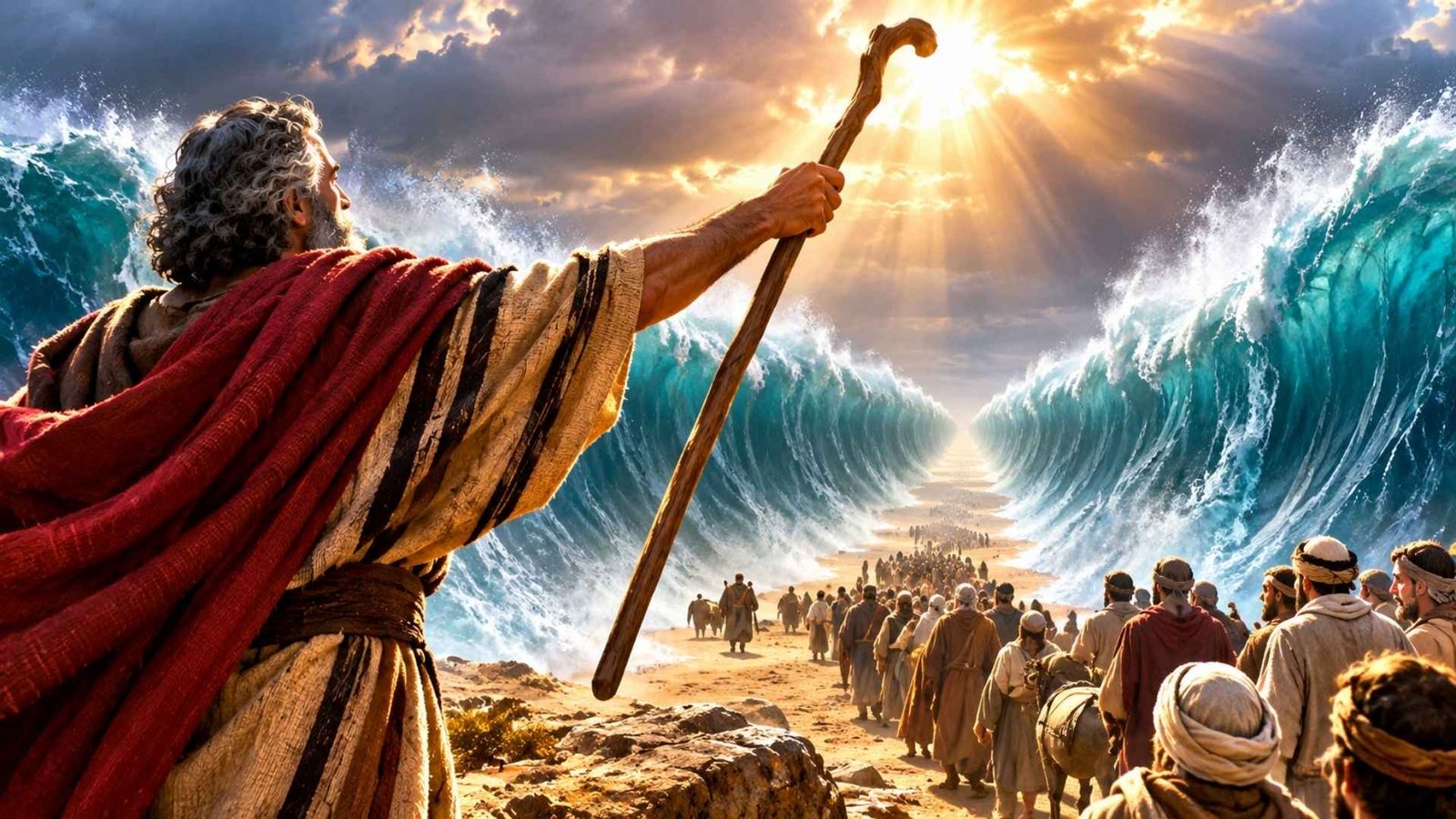
When Israel stood before an impossible situation, God instructed Moses to lift up his rod.
Exodus 14:16 records God’s instruction:
“But lift thou up thy rod, and stretch out thine hand over the sea, and divide it: and the children of Israel shall go on dry ground through the midst of the sea.”
The rod was lifted, the waters divided, and Israel crossed over on dry ground.
Reading this account alongside the New Testament reveals an interesting Christological connection. Could the rod lifted by Moses, the opening of the Red Sea, and Israel’s deliverance point towards the greater work of Jesus Christ?
We must be careful not to claim that Scripture explicitly identifies Moses’ rod as Christ. It does not. However, the Exodus narrative contains redemptive patterns that the New Testament connects to the person and work of Christ.
The deeper revelation is not necessarily in the identity of the rod, but in the deliverance it facilitated and the greater Deliverer to whom the entire biblical narrative points.
1. The Rod of Moses: An Ordinary Instrument in the Hands of God
Before examining the Red Sea experience, we must understand the significance of Moses’ rod.
In Exodus 4:1–5, Moses questioned how the Israelites would believe that God had sent him. God instructed him to throw his rod onto the ground. When he did, it became a serpent. God subsequently instructed him to take it by the tail, and it became a rod again.
This encounter established something important: God could use an ordinary instrument to demonstrate His extraordinary authority.
The rod subsequently became associated with several supernatural demonstrations in Egypt.
In Exodus 7:17–20, Moses stretched out his rod over the waters of Egypt, and the Nile turned into blood. In Exodus 8:5–6, Aaron stretched out his rod over the waters, and frogs came upon the land. In Exodus 9:23, Moses stretched out his rod towards heaven, and the Lord sent thunder and hail.
The rod became a visible instrument in the demonstration of God’s authority.
However, we must recognise the distinction between the instrument and the One who empowered it.
The rod had no independent supernatural authority. Its significance came from God’s instruction and presence.
This introduces an important spiritual principle: God’s power is not contained in the instrument; the instrument derives its significance from the God who uses it.
Moses was not the source of the miracles, and neither was the rod. God was the One performing the mighty works.
2. The Rod Was Lifted Over the Sea: The Mystery of Deliverance
The account of Exodus 14 presents one of the most dramatic moments in Israel’s history.
After years of slavery in Egypt, Pharaoh finally permitted the Israelites to leave. But shortly after their departure, he changed his mind and pursued them with his army.
Israel found itself trapped.
Before them was the Red Sea. Behind them was Pharaoh’s advancing army. Human reasoning offered no obvious escape.
The people became afraid and questioned Moses.
But Moses declared in Exodus 14:13:
“Fear ye not, stand still, and see the salvation of the LORD, which he will shew to you to day…”
God then instructed Moses to lift his rod and stretch out his hand over the sea.
Exodus 14:21 records:
“And Moses stretched out his hand over the sea; and the LORD caused the sea to go back by a strong east wind all that night, and made the sea dry land, and the waters were divided.”
Notice the relationship between the instruction and the miracle.
Moses lifted the rod, but the Lord caused the waters to divide.
The rod was the instrument; God was the Deliverer.
The sea became a passage through which an enslaved people moved towards freedom.
The significance of this event extends beyond the physical escape from Egypt. It became a defining moment in Israel’s identity as a people delivered by God.
They did not defeat Pharaoh through military strength. Their deliverance was an act of divine intervention.
3. From the Rod to the Cross: A Picture of Redemption
Here is where the Christological connection becomes particularly interesting.
The New Testament presents Jesus Christ as the ultimate Deliverer, whose death and resurrection accomplish redemption from sin and death.
Consider the similarities between the Exodus narrative and the Gospel.
Israel was in bondage under Pharaoh. Humanity, according to the New Testament, is in bondage to sin.
Israel needed deliverance from Egypt. Humanity needs reconciliation with God.
God raised Moses to lead Israel out of Egypt. God sent His Son, Jesus Christ, to accomplish humanity’s redemption.
Israel passed through the divided sea into freedom. Through Christ’s death and resurrection, believers are brought into newness of life.
The comparison is not intended to suggest that every detail of the Exodus has a direct symbolic equivalent in the Gospel. Rather, the Exodus establishes a biblical pattern of redemption: God delivers His people from bondage and brings them into a new life under His authority.
The cross is the fulfilment of God’s greater redemptive purpose.
Moses was a servant through whom God delivered Israel from Egypt. Jesus is the Son who accomplishes the ultimate deliverance.
Moses led a nation out of physical bondage; Christ delivers humanity from the dominion of sin.
4. The Bronze Serpent: When Jesus Himself Revealed the Mystery of Being Lifted Up
There is another Old Testament event that gives us an even stronger biblical foundation for this discussion.
In Numbers 21:4–9, Israel became impatient during its wilderness journey and spoke against God and Moses.
Fiery serpents came among the people, and many were bitten.
The people recognised their wrongdoing and asked Moses to intercede.
God instructed Moses to make a bronze serpent and place it upon a pole. Anyone who had been bitten could look at the bronze serpent and live.
This event becomes especially significant in John 3:14–15, where Jesus says:
“And as Moses lifted up the serpent in the wilderness, even so must the Son of man be lifted up: That whosoever believeth in him should not perish, but have eternal life.”
Here, Jesus explicitly connects an Old Testament event with His crucifixion.
The bronze serpent was lifted up, and those who looked upon it lived. Similarly, the Son of Man would be lifted up, and those who believe in Him would receive eternal life.
Notice that Jesus Himself provides the interpretation.
This is important because it establishes that Old Testament events can carry a prophetic or typological significance that finds fulfilment in Christ.
However, Jesus specifically identifies the bronze serpent as the comparison in this passage, not Moses’ rod at the Red Sea.
Nevertheless, both events belong to the wider biblical story of divine deliverance.
The bronze serpent points directly to Christ’s being lifted up, while the Red Sea demonstrates God’s power to deliver His people from bondage.
5. The Rock Was Christ: Paul’s Revelation of the Exodus Experience
Perhaps one of the most remarkable New Testament connections to the Exodus narrative is found in 1 Corinthians 10:1–4.
Paul reminds the Corinthian believers about Israel’s wilderness experience.
He speaks of the cloud, the crossing of the sea, the spiritual food, and the spiritual drink.
Then he makes an extraordinary statement:
“And did all drink the same spiritual drink: for they drank of that spiritual Rock that followed them: and that Rock was Christ.” — 1 Corinthians 10:4.
Paul explicitly identifies Christ in connection with Israel’s wilderness experience.
This is significant.
The Exodus was not merely a historical account of people escaping Egypt. Paul draws spiritual lessons from it for the New Testament church.
The Israelites experienced divine provision, guidance, and protection, yet many failed to remain faithful to God.
Paul uses their experience as a warning against idolatry, immorality, and spiritual presumption.
But his identification of the Rock as Christ also reveals the continuity of God’s redemptive purpose.
Christ is not an afterthought in the story of redemption. The entire biblical narrative finds its centre and fulfilment in Him.
This does not mean that the rod itself was Christ. Paul identifies the spiritual Rock as Christ.
The distinction matters because biblical interpretation must be built on what Scripture reveals rather than what we might wish every detail to represent.
6. The Sea Opened, but Christ Became the Way
There is another connection worth considering.
When the Red Sea opened, Israel received a way through an otherwise impossible situation.
The sea did not simply disappear. God created a passage through it.
In the New Testament, Jesus makes a remarkable declaration in John 14:6:
“I am the way, the truth, and the life: no man cometh unto the Father, but by me.”
The language of the way is central to understanding the Gospel.
Humanity needed a way of reconciliation with God. Jesus Christ came to accomplish that reconciliation.
Hebrews 10:19–20 explains that believers have confidence to enter God’s presence through the blood of Jesus, by a new and living way opened through His flesh.
The Red Sea crossing was a historical deliverance. Christ’s death and resurrection accomplish the greater redemption.
At the Red Sea, God opened a passage through the waters. Through Christ, God opened the way into His presence.
This is the greater revelation.
The sea became Israel’s passage from Egypt, but Christ became humanity’s way to the Father.
7. The Rod Was Lifted, but the Power Belonged to God
One of the most important lessons from Moses’ rod is the distinction between delegated authority and divine power.
Moses could lift the rod, but he could not command the sea by his own authority.
God gave the instruction, and God performed the miracle.
This principle is relevant to Christian ministry today.
Spiritual authority is not an independent possession that allows people to exercise supernatural power according to their personal desires.
All authority belongs to God, and Christian ministry operates under the lordship of Jesus Christ.
We must therefore avoid turning biblical instruments into objects of superstition.
The rod of Moses was not a magical object. Its significance came from God’s instruction.
Likewise, the cross is not merely a religious ornament or symbol. Its significance rests in the person and finished work of Jesus Christ.
Our confidence is not in religious objects, rituals, or human personalities. Our confidence is in Christ.
8. From Egypt to the Promised Land: The Journey of Redemption
The crossing of the Red Sea was not the final destination of Israel.
It was the beginning of a journey.
God delivered Israel from Egypt, but the nation still had to journey through the wilderness towards the Promised Land.
This distinction is spiritually important.
Salvation is not simply an escape from the consequences of sin. It introduces us into a new relationship with God and a life of discipleship.
Colossians 1:13–14 declares that God has delivered believers from the power of darkness and translated them into the kingdom of His dear Son, in whom we have redemption through His blood.
Through Christ, we have been brought into a new kingdom.
Yet, we must continue to grow in faith, obedience, holiness, and spiritual maturity.
The Israelites’ wilderness experience reminds us that experiencing deliverance does not remove the need for continued faithfulness.
Paul’s warning in 1 Corinthians 10 is precisely that many Israelites experienced God’s deliverance but subsequently fell into disobedience.
We must therefore learn from their history.
Deliverance brings us out of bondage; discipleship teaches us how to walk in the freedom we have received.
Conclusion: The Rod, the Sea, and the Greater Deliverer
The rod of Moses occupies an extraordinary place in the Exodus narrative.
It was lifted before Pharaoh, stretched over the waters, and used in the demonstration of God’s authority.
At the Red Sea, its lifting preceded one of the greatest acts of deliverance recorded in Scripture.
Although the Bible does not explicitly identify Moses’ rod as a symbol of Christ, the events surrounding it reveal a redemptive pattern that finds its greater fulfilment in Jesus.
The bronze serpent gives us an explicit example of Christological typology because Jesus Himself connected it to His crucifixion.
Paul further reveals that Christ was the spiritual Rock associated with Israel’s wilderness experience.
Together, these passages remind us that Christ stands at the centre of God’s redemptive story.
Moses was a deliverer, but Christ is the Saviour.
The rod was an instrument, but Christ is the Redeemer.
The sea opened, but Christ is the Way.
Egypt represented bondage, but Christ brings us into the freedom of salvation.
The greatest revelation is therefore not the power of the rod, but the faithfulness of the God who delivered Israel and the saving work of Jesus Christ, through whom we have redemption.
The rod was lifted, the sea was divided, and Israel walked into freedom. But in Christ, God has accomplished a greater deliverance: He has opened the way for humanity to be reconciled to Himself.
Prayer
Heavenly Father,
Thank You for revealing Your power and faithfulness through the history of Israel. Thank You for sending Jesus Christ, our ultimate Deliverer, through whom we have redemption and eternal life.
Help us to understand Your Word with wisdom and discernment. May we never place our confidence in instruments, personalities, or religious appearances, but in You alone.
Teach us to walk in the freedom Christ has purchased for us. Deliver us from the bondage of sin, strengthen our faith, and lead us into spiritual maturity.
May our lives continually reflect the victory and redemption we have received through Jesus Christ.
In Jesus’ name. Amen.
Scriptures for Further Study
- Exodus 4:1–5 — The rod of Moses.
- Exodus 7:8–20 — The rod before Pharaoh.
- Exodus 14:13–31 — The crossing of the Red Sea.
- Numbers 21:4–9 — The bronze serpent lifted up.
- John 3:14–17 — The Son of Man lifted up.
- John 14:1–6 — Jesus, the Way, the Truth, and the Life.
- 1 Corinthians 10:1–13 — Christ in Israel’s wilderness experience.
- Hebrews 3:1–6 — Christ greater than Moses.
- Hebrews 10:19–22 — The new and living way.
- Colossians 1:12–14 — Delivered from the power of darkness.










