
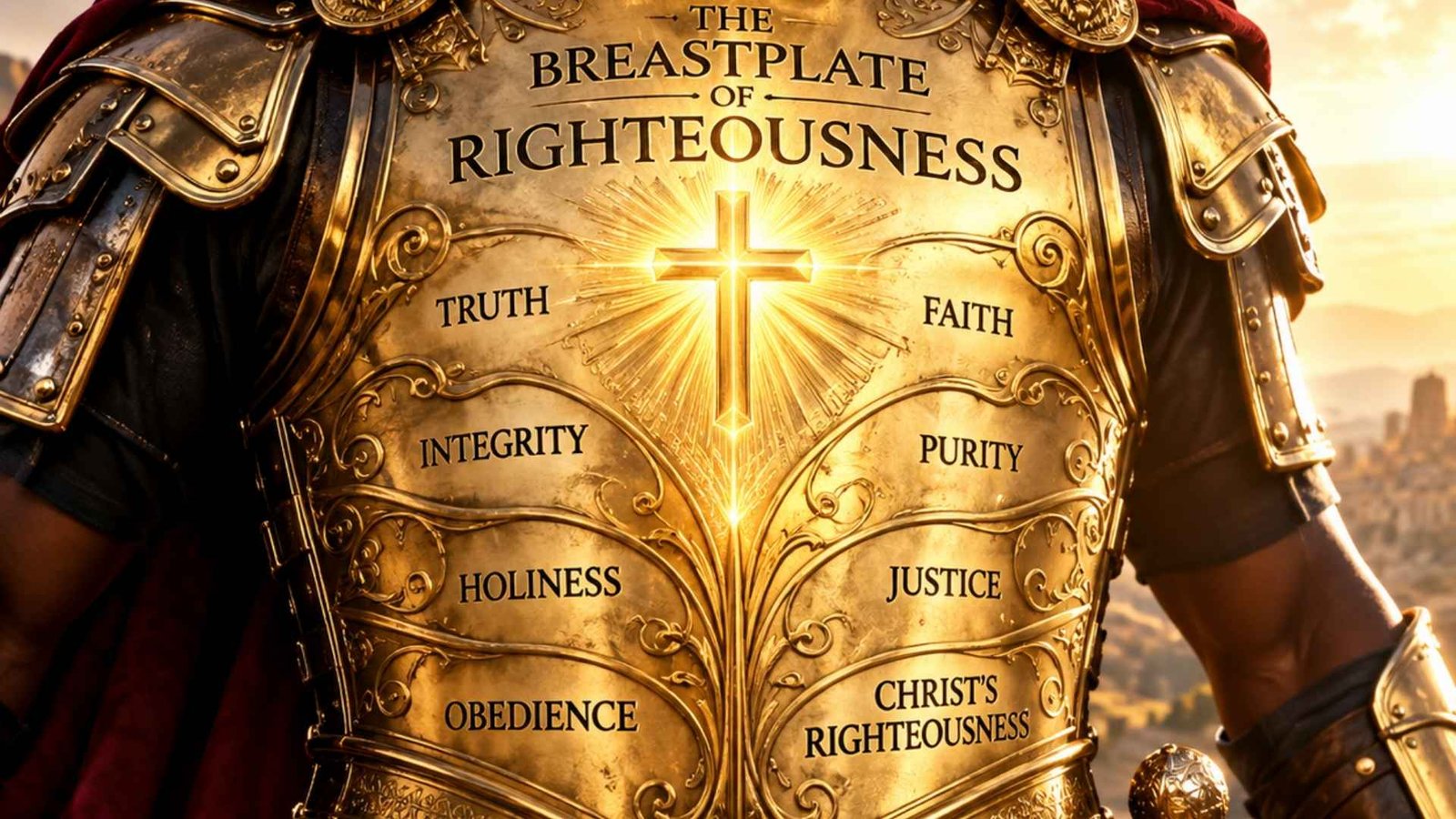
The Breastplate of Righteousness
Understanding the Spiritual Armour That Guards the Heart and Shapes the Life of a Believer
Key Scripture: Ephesians 6:14
“Stand therefore, having your loins girt about with truth, and having on the breastplate of righteousness.” — Ephesians 6:14 (KJV)
In the ancient world, a soldier’s breastplate served a vital purpose: it protected some of the most vulnerable parts of his body, particularly the chest and vital organs. A soldier could possess a sword, a shield, and a helmet, but without adequate protection for his torso, he remained exposed to potentially fatal injuries.
When the Apostle Paul describes the armour of God in Ephesians 6, he uses this familiar image to communicate a profound spiritual principle. Among the pieces of armour he identifies is the breastplate of righteousness.
Paul does not introduce righteousness as a decorative quality of the Christian life. He presents it as essential equipment for standing firm against the schemes of the devil.
This raises an important question: Why does righteousness occupy such a strategic place in the armour of God? What does it protect, how does it function, and what does it mean for a believer to wear it?
To understand the breastplate, we must first understand the nature of righteousness itself.
Righteousness: The Foundation of Spiritual Protection
Ephesians 6:14 instructs believers to put on the breastplate of righteousness. Yet the meaning of righteousness must be understood within the wider message of Scripture.
At its core, righteousness concerns what is right before God. It involves God’s own perfect righteousness, the righteous standing believers receive through faith in Jesus Christ, and the practical righteousness expressed through a life of obedience.
These dimensions are connected, but they are not identical.
First, Scripture teaches that our right standing before God is not something we can earn through our own moral achievements. Romans 3:22–24 explains that God’s righteousness comes through faith in Jesus Christ and that people are justified by His grace.
Second, believers are called to live righteously. Ephesians 4–5, which precedes Paul’s description of spiritual armour, repeatedly instructs Christians to abandon the old way of life and walk in truth, holiness, love, and obedience.
Therefore, the breastplate of righteousness should not be reduced to the idea that we become spiritually protected simply by performing enough good deeds. Nor should it be understood as a licence to live carelessly because we have received grace.
The gospel establishes our relationship with God through Christ, and that relationship calls us into a transformed life.
Righteousness is both a gift to be received through Christ and a way of life to be pursued in obedience to Him.
This distinction is essential. We do not obey God to purchase His acceptance; we pursue righteousness because we belong to Him.
Why a Breastplate? The Protection of the Inner Person
A breastplate protects the chest. In Paul’s metaphor, it represents an essential element of the believer’s spiritual preparedness.
The Bible frequently uses the heart as a picture of the inner person: our thoughts, desires, motives, decisions, and moral disposition.
Proverbs 4:23 declares, “Keep thy heart with all diligence; for out of it are the issues of life.”
The verse emphasises that the inner condition of a person influences the direction of life. What we repeatedly entertain, desire, and permit within ourselves eventually affects our outward conduct.
Consider how temptation often develops. A person may begin by entertaining a dishonest thought, then justify a small compromise, and eventually establish a pattern of behaviour that damages relationships, character, and spiritual integrity.
The external action may become visible only after the internal compromise has been allowed to grow.
This is one reason righteousness is such an important image of protection. A commitment to what is right helps guard the inner person against the gradual corruption that begins with neglected convictions.
When we cultivate truthfulness, sexual integrity, justice, humility, self-control, and obedience to God’s Word, we develop habits that make it harder for destructive desires to govern our lives.
This does not mean that righteous people never experience temptation or spiritual attack. It means that righteousness is an essential part of the life through which believers resist evil and remain faithful to God.
The breastplate reminds us that spiritual warfare is not fought only through declarations, prayers, or public displays of faith. It also involves the daily decisions that preserve the integrity of our inner lives.
The Righteousness of Christ: Protection Against Condemnation
There is another important dimension to the breastplate: the believer’s standing before God.
Satan is described in Revelation 12:10 as “the accuser of our brethren.” Scripture also acknowledges the reality of guilt, sin, and the human tendency to condemn ourselves.
When we recognise our failures, we may be tempted to conclude that we are beyond forgiveness or that our mistakes have permanently disqualified us from serving God.
The answer is not to pretend that sin does not matter. The answer is to understand the sufficiency of Christ.
Romans 8:1 declares that there is no condemnation for those who are in Christ Jesus. First John 1:9 teaches that when we confess our sins, God is faithful and just to forgive us and cleanse us from all unrighteousness.
These promises do not encourage careless living. They provide a foundation for repentance without despair.
The righteousness of Christ means that our hope before God rests on what Christ has accomplished, not on a claim that we have never sinned.
When we fail, we do not need to hide behind excuses or surrender to hopelessness. We can confess our wrongdoing, receive God’s forgiveness, make necessary changes, and continue walking in obedience.
Here, the breastplate becomes a helpful picture of confidence grounded in the gospel. Our assurance is not that we have achieved moral perfection, but that our relationship with God rests on His grace through Christ.
The believer’s confidence is not in the claim, “I have never failed,” but in the truth, “Christ is my righteousness, and by His grace I can repent, rise, and walk in obedience.”
Practical Righteousness: Protecting Your Witness and Character
The righteousness that believers receive through Christ must not be separated from the righteousness they are called to practise.
Paul’s description of the armour comes in Ephesians 6:10–18, but the same letter provides practical instruction about the life that should accompany this spiritual readiness.
Ephesians 4:25 tells believers to put away falsehood and speak truthfully. Ephesians 4:28 instructs those who stole to stop stealing and instead work honestly, so that they may have something to share with those in need. Ephesians 4:29 warns against corrupt speech and encourages words that build others up.
These are not unrelated moral suggestions. They show what a life shaped by righteousness looks like in everyday circumstances.
Consider the business owner who refuses to deceive a customer, even when dishonesty would increase profit. Consider the leader who treats employees fairly instead of exploiting their vulnerability. Consider the minister who refuses to manipulate people through fear or promises that God has not made. Consider the believer who chooses forgiveness rather than allowing resentment to control every interaction.
Each decision represents an opportunity to practise righteousness.
Such choices may sometimes appear costly. Honesty can cost a sale. Integrity can cost an opportunity. Refusing to participate in wrongdoing can create conflict with people who benefit from it.
Nevertheless, righteousness protects something more valuable than immediate advantage: the integrity of our character and the credibility of our witness.
This does not guarantee that every righteous person will prosper materially or avoid suffering. Scripture contains many examples of faithful people who endured injustice. Rather, righteousness enables us to remain faithful to God even when doing what is right carries a cost.
A believer who continually compromises truth may retain a public reputation for a time, but the inner life becomes increasingly vulnerable to hypocrisy, guilt, and destructive habits.
The breastplate of righteousness calls us to build a life whose private conduct supports its public confession.
Joseph: Righteousness When Nobody Is Watching
Joseph’s experience in Genesis 39 provides a powerful illustration of practical righteousness.
After being sold into slavery, Joseph served in the household of Potiphar. Potiphar’s wife attempted to persuade him to engage in sexual immorality.
Joseph refused, asking, “How then can I do this great wickedness, and sin against God?” (Genesis 39:9).
His response reveals the foundation of his decision. He did not measure the situation merely by the likelihood of being caught. He understood that his conduct mattered before God.
Joseph ultimately fled the temptation, but his integrity did not protect him from every immediate consequence. Potiphar’s wife falsely accused him, and he was imprisoned.
This detail is crucial. The story does not teach that righteousness always produces instant protection from injustice. Joseph suffered despite making the right choice.
Yet his refusal to compromise preserved his integrity before God, even when his circumstances appeared to contradict the benefits of faithfulness.
The breastplate of righteousness is not a promise that nothing painful will happen to us. It is a call to remain morally and spiritually grounded when pressure invites us to abandon our convictions.
Joseph’s story teaches us that the right decision does not always produce the easiest immediate outcome. Sometimes righteousness must be chosen because it is right, not because it guarantees a reward.
Righteousness and the Accusations of the Enemy
One of the most damaging consequences of persistent wrongdoing is that it creates opportunities for accusation, shame, and spiritual instability.
When a person knowingly lives in contradiction to their convictions, they may begin to conceal their actions, rationalise their behaviour, or withdraw from accountability. The resulting inner conflict can weaken their confidence and damage their relationships.
This does not mean every feeling of guilt comes from the devil. Conscience can rightly alert us to wrongdoing, and the Holy Spirit convicts people of sin. We must distinguish between conviction that leads us toward repentance and condemnation that drives us toward hopelessness.
Second Corinthians 7:10 distinguishes godly sorrow, which produces repentance, from worldly sorrow, which produces death.
The practical lesson is important: when we discover sin in our lives, we must not protect it merely to preserve our image. We should bring it into the light, confess it to God, seek appropriate accountability where necessary, and take concrete steps toward change.
At the same time, we must refuse to let past failures become the final definition of our identity in Christ.
The breastplate of righteousness points us toward both moral seriousness and gospel confidence. We must not make peace with sin, but neither should we deny the power of God’s grace to forgive and restore the repentant.
How Do We Put on the Breastplate of Righteousness?
Putting on the breastplate is not a mystical exercise in which we imagine ourselves wearing spiritual armour and assume that our responsibilities are complete. Paul’s imagery calls believers to become spiritually prepared and to stand firm in the Lord.
Practically, this involves several commitments.
Receive your righteousness through Christ. Do not build your confidence before God on self-righteousness or personal achievement. Trust in Christ, whose grace makes reconciliation with God possible.
Practise obedience daily. Make righteous choices in your finances, relationships, business dealings, speech, private conduct, and use of authority. Integrity is formed through repeated decisions.
Reject compromise early. Do not assume that small acts of dishonesty or hidden habits are harmless. Address temptation before it becomes an established pattern.
Respond to conviction with repentance. When you recognise wrongdoing, acknowledge it honestly and make the changes required. Do not confuse repentance with self-hatred or despair.
Guard your motives as well as your actions. It is possible to perform outwardly good deeds while being driven by pride, manipulation, or a desire for recognition. Invite God to examine the heart and shape your intentions.
Remain grounded in Scripture. Let God’s Word define righteousness rather than relying exclusively on cultural expectations, personal preferences, or the approval of other people.
These practices do not earn salvation. They are expressions of a life being formed by God’s grace and truth.
Conclusion: Do Not Fight Spiritual Battles With a Compromised Heart
The breastplate of righteousness reveals that spiritual readiness involves more than knowing the language of spiritual warfare. It involves living in a way that is consistent with the God we profess to serve.
We cannot claim that righteousness is unimportant while expecting to stand firmly in the truth. We cannot continually excuse dishonesty, injustice, bitterness, and immorality while ignoring the effect these things have on our spiritual lives.
At the same time, our hope must remain anchored in Jesus Christ. Our confidence is not in our ability to live without ever making a mistake, but in the grace of God that justifies, forgives, corrects, and transforms us.
The breastplate of righteousness calls us to hold these truths together: we are accepted through Christ, and we are called to walk in righteousness.
Do not merely seek power to overcome what is outside you. Allow God to address what is happening within you. Do not only ask for victory over temptation; cultivate the integrity that helps you resist it. Do not only pray against accusation; walk honestly before God and receive His grace when you fall.
A life grounded in Christ’s righteousness and shaped by practical obedience is a life prepared to stand firm when temptation, pressure, and accusation arise.
A Prayer
Heavenly Father, thank You for the righteousness made available to me through Jesus Christ. Teach me to depend on Your grace rather than my own achievements. Guard my heart against deception, compromise, pride, and hidden sin. Give me courage to choose what is right even when it is costly, humility to repent when I fail, and wisdom to walk in truth in every area of my life. Let my character reflect the righteousness I profess, and help me stand firm in faith when temptation and accusation arise. In Jesus’ name, Amen.
Scriptures for Further Study
- Ephesians 6:10–18 — The whole armour of God.
- Romans 3:21–26 — Righteousness through faith in Jesus Christ.
- Romans 8:1–4 — No condemnation in Christ.
- Proverbs 4:23 — Guarding the heart.
- Genesis 39:7–23 — Joseph’s integrity under pressure.
- Ephesians 4:17–32 — The practical expression of a transformed life.
- Philippians 3:8–9 — Righteousness through faith in Christ.
- 1 John 1:5–9 — Walking in the light, confession, and forgiveness.
- 2 Corinthians 7:10 — Godly sorrow and repentance.










