
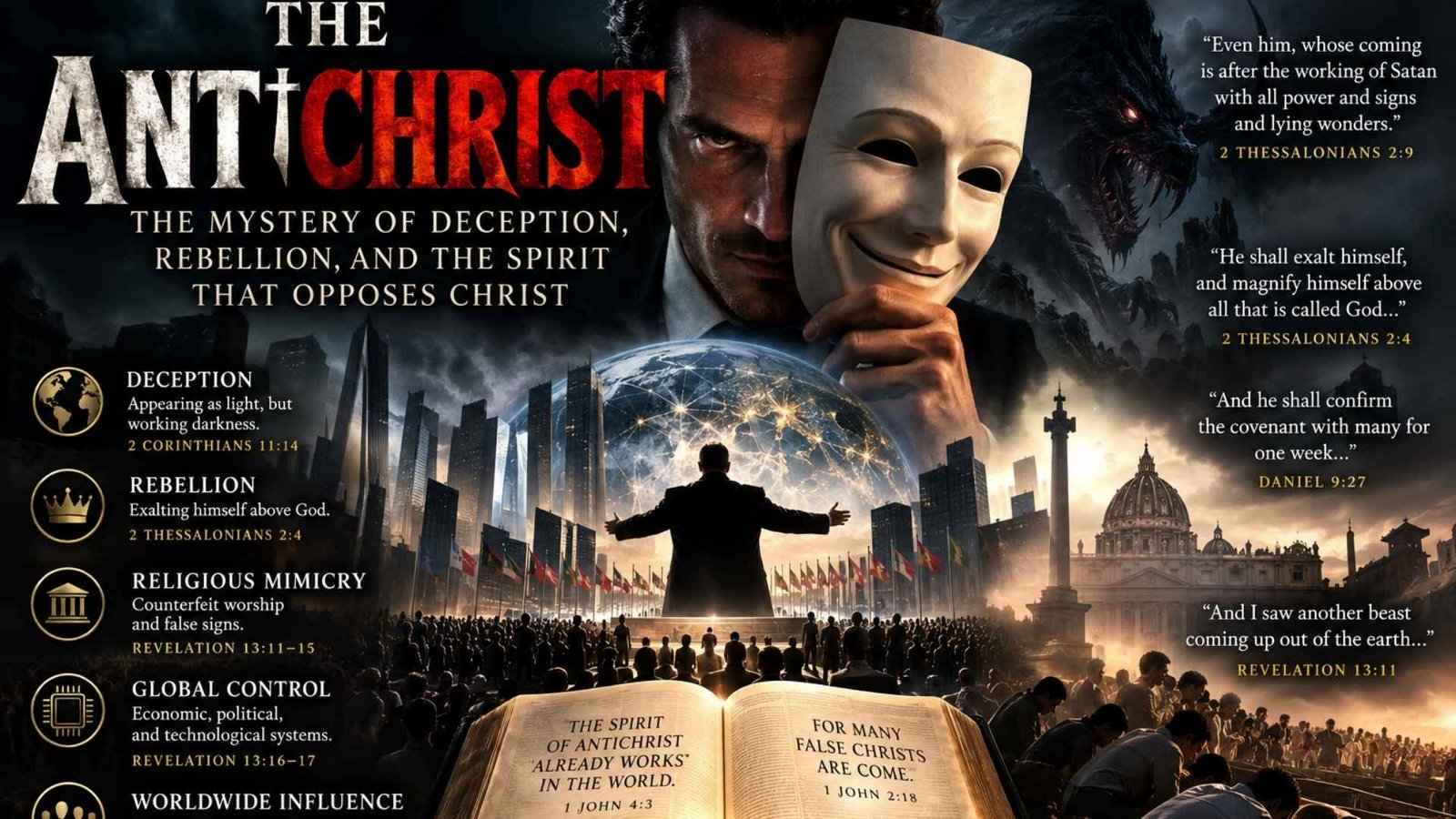
The Antichrist: The Mystery of Deception, Rebellion, and the Spirit That Opposes Christ
Key Scriptures
- 1 John 2:18–23 — The coming of antichrists and the spirit of denial.
- 2 Thessalonians 2:1–12 — The man of lawlessness and the great deception.
- Daniel 7:23–27 — The kingdom that opposes the saints of the Most High.
- Revelation 13:1–18 — The beast, its authority, and the deception of the earth.
Introduction: The Mystery Behind the Antichrist
Few biblical subjects have generated as much curiosity, speculation, and controversy as the Antichrist. Across generations, Christians have attempted to identify this figure, interpret the signs of the times, and understand how the final opposition to God will unfold.
Yet beneath the debates about identity, prophecy, political power, and the end of the age lies a deeper biblical concern: the opposition to Jesus Christ and the deception that attempts to turn humanity away from the truth of God.
The Bible does not present the subject through one passage alone. The apostle John speaks of antichrists who deny the Father and the Son. Paul describes a figure associated with lawlessness and deception. Daniel presents visions of arrogant powers that oppose God’s people, while Revelation depicts beasts that exercise authority, demand allegiance, and wage war against the saints.
These passages are related, but they should not automatically be treated as identical descriptions without careful interpretation.
The term antichrist appears explicitly in the letters of John, not in Revelation. Nevertheless, Christians have long explored the relationship between John’s antichrists, Paul’s man of lawlessness, Daniel’s hostile rulers, and Revelation’s beasts.
To understand this mystery responsibly, we must distinguish what Scripture clearly states from the interpretations Christians have developed about how these prophetic pictures relate to one another.
The central question is not merely, “Who is the Antichrist?” It is also, “How does the spirit of opposition to Christ operate, and how can believers remain faithful amid deception?”
1. The Meaning of Antichrist: Opposition and Counterfeit
The word antichrist is associated with opposition to Christ and, in the broader interpretation of the term, the attempt to take His place or present a counterfeit of His authority.
The apostle John provides the clearest biblical explanation.
First John 2:18 declares:
“Little children, it is the last time: and as ye have heard that antichrist shall come, even now are there many antichrists.” — KJV
Notice the distinction in John’s statement. He refers both to the expectation of an antichrist and to the presence of many antichrists already operating in his own time.
This means the biblical concept cannot be reduced exclusively to a future individual. John identifies a pattern of opposition that was already evident within the early Christian community.
In 1 John 2:22, he identifies the liar as the one who denies that Jesus is the Christ and describes the denial of the Father and the Son as central to this deception. In 1 John 4:2–3, he connects the spirit of antichrist with the rejection of the truth concerning Jesus Christ’s coming in the flesh.
The issue is therefore fundamentally Christological: it concerns who Jesus is and whether the truth about Him is received or rejected.
This gives us an important starting point. Antichrist is not merely a label for a wicked ruler, a hostile government, or a person whose actions Christians dislike. In John’s writings, the term is connected directly to the rejection of Christ and the distortion of the truth about Him.
The opposition to Christ begins wherever the truth about His identity and lordship is denied, distorted, or replaced.
2. Many Antichrists: The Pattern Before the Final Manifestation
John’s statement that many antichrists had already appeared is one of the most important details in the biblical discussion.
First John 2:19 describes people who departed from the Christian community, revealing that their departure exposed a deeper division concerning the truth. In the surrounding verses, John warns believers about deception and urges them to remain in what they have heard from the beginning.
This suggests that opposition to Christ can emerge from within a religious environment, not only from openly hostile external forces.
A person may use religious language while presenting a distorted understanding of Jesus. A teacher may claim spiritual authority while leading people away from the apostolic Gospel. A movement may retain Christian terminology while changing the meaning of Christ’s identity, work, and lordship.
John’s concern is not simply that believers might encounter people who hate Christianity. His warning includes those who misrepresent the truth about Christ.
This has practical implications for the Church today. Christians must evaluate teaching by Scripture rather than by charisma, popularity, emotional intensity, or the apparent success of a ministry.
Miraculous claims, impressive crowds, confident declarations, and public influence do not independently establish that a message is true.
At the same time, believers should not casually accuse every teacher with whom they disagree of being an antichrist. John’s language concerns serious opposition to the truth about Jesus, not every difference in interpretation or personality.
The responsibility is to exercise discernment without surrendering to suspicion.
3. The Man of Lawlessness: When Rebellion Exalts Itself
In 2 Thessalonians 2:1–12, Paul addresses confusion concerning the day of the Lord. He warns believers not to be quickly shaken or deceived into thinking that the day has already arrived.
Paul then describes a figure he calls the man of lawlessness, also rendered the man of sin in some English translations.
Second Thessalonians 2:3–4 describes this figure as opposing and exalting himself above what is called God or worshipped, even presenting himself in connection with the temple of God.
The passage portrays an extraordinary expression of rebellion against divine authority.
The figure does not merely break ordinary rules. He exalts himself against God, seeking a position that belongs to God alone.
Paul also speaks of a mystery of lawlessness already at work, while describing a future manifestation associated with the coming of the lawless one. His account therefore contains both a present dimension of rebellion and an anticipated climactic confrontation.
Christians disagree about the precise identity of this figure and the timing of the events Paul describes. Some interpret the passage as referring to a future individual who will emerge in a final period of opposition. Others emphasise historical fulfilments, symbolic dimensions, or patterns of lawless power that recur throughout history.
The passage should not be forced into a single modern political identification without sufficient evidence.
What remains clear is Paul’s central contrast: the lawless one operates through deception and self-exaltation, but his apparent power is temporary. In 2 Thessalonians 2:8, Paul declares that the Lord Jesus will destroy him by the manifestation of His coming.
The final emphasis is not the greatness of the deceiver but the supremacy of Christ.
Lawlessness may exalt itself for a season, but no power that opposes God possesses the authority to overturn His final purpose.
4. Daniel’s Vision: The Kingdom That Opposes the Saints
Long before Paul’s letter to the Thessalonians, the book of Daniel presented visions of kingdoms and rulers who opposed God’s purposes.
Daniel 7 describes four beasts arising from the sea, followed by a vision of a little horn that speaks arrogantly and makes war against the saints. The vision culminates in the judgment of the Ancient of Days and the establishment of the dominion given to one like a son of man.
Daniel 7:13–14 describes this figure receiving dominion, glory, and a kingdom that will not pass away.
The contrast is striking. Human powers rise, boast, persecute, and eventually fall, but the kingdom given by God endures.
Daniel’s visions emerged in a historical context marked by the experience of powerful empires and, in later portions of the book, persecution and pressure to abandon faithfulness to God. The little horn has therefore been interpreted in several ways, including historical rulers and a future opponent of God.
Some Christian traditions connect Daniel’s hostile ruler with Paul’s man of lawlessness and the Antichrist. Other interpreters distinguish the historical referents more sharply.
Regardless of the precise prophetic framework, Daniel’s message is clear: political and military power is not absolute. The authority of earthly kingdoms remains subject to the judgment of God.
This is particularly important when considering the Antichrist. Scripture does not teach believers to worship power simply because it appears unstoppable. Nor does it suggest that the success of an oppressive system proves divine approval.
The faithful are called to discern the character of power, remain loyal to God, and remember that the kingdoms of this world are not eternal.
5. Revelation 13: The Beast, False Worship, and Competing Allegiances
Revelation 13 presents one of the Bible’s most vivid pictures of opposition to God.
John sees a beast rising from the sea, receiving authority, blaspheming God, and waging war against the saints. Later, another beast emerges from the earth, performing signs and directing people toward the worship of the first beast.
The chapter depicts a system of authority sustained by deception, coercion, and false worship.
The second beast is commonly called the false prophet in Christian interpretation, although Revelation 13 initially describes it as a beast from the earth. Revelation 19:20 later identifies the false prophet with the figure who performed signs in the presence of the first beast.
The imagery draws on the prophetic traditions of Daniel, where beasts symbolise hostile kingdoms and rulers. Revelation uses this language to portray power that demands allegiance in opposition to God.
Revelation 13:16–18 also introduces the mark of the beast and the number 666. This passage has generated numerous interpretations throughout Christian history.
Some understand the beast primarily through the historical realities of the Roman imperial world and its demands for loyalty. Others see the imagery as extending toward a future final manifestation of evil. Still others understand aspects of the vision symbolically as recurring patterns of coercive political, economic, and religious power.
These approaches should not be collapsed into a claim that one contemporary technology, identification system, or political institution has conclusively fulfilled the prophecy.
Revelation’s imagery must be interpreted within the book’s wider message concerning worship, allegiance, endurance, and the victory of the Lamb.
The fundamental issue is not simply whether a person can recognise a mysterious number. It is whether God’s people will remain faithful when the surrounding world pressures them to compromise their allegiance to Him.
6. The Deception of the Antichrist: Signs Without Truth
One of the most serious warnings in 2 Thessalonians 2 concerns deception.
Paul states that the coming of the lawless one is associated with the working of Satan, accompanied by power, signs, lying wonders, and unrighteous deception.
This warning challenges the assumption that supernatural appearances automatically prove divine approval.
In the biblical worldview, signs must be considered alongside the truth of God’s revelation. A display of power does not excuse falsehood, and an extraordinary experience does not remove the need for discernment.
Jesus similarly warns in Matthew 24:24 that false christs and false prophets will arise and show great signs and wonders, seeking to deceive, if possible, even the elect.
The danger is not merely that people may believe something obviously evil. Deception often works by presenting something attractive, convincing, or apparently beneficial while leading people away from the truth.
A religious message may promise influence but neglect repentance. A leader may claim divine authority while demanding unquestioning loyalty. A movement may celebrate miracles while obscuring the character and teaching of Jesus.
The test is not simply whether a message appears powerful. It is whether it remains faithful to the Gospel and produces allegiance to Christ rather than the exaltation of a human personality.
This does not mean every unusual spiritual experience is deceptive. Scripture itself records genuine miracles and the work of the Holy Spirit. The point is that claims of supernatural power must never be treated as substitutes for truth.
The most dangerous deception is not always the lie that looks like a lie; sometimes it is the lie that borrows the appearance of truth.
7. The Spirit of Antichrist and the Church’s Responsibility
First John 4:1 instructs believers not to believe every spirit but to test the spirits to determine whether they are from God. John then identifies the confession of Jesus Christ come in the flesh as a central test.
This instruction places discernment at the heart of Christian maturity.
The Church is not called to become obsessed with identifying the Antichrist while neglecting the work of discipleship. It is called to remain faithful to Jesus, guard the truth of the Gospel, love one another, and resist deception.
This requires more than the ability to interpret prophetic symbols. It requires a deep understanding of Scripture, a willingness to be corrected, and a life shaped by the character of Christ.
In practical terms, believers should be cautious when a spiritual leader claims authority that cannot be questioned, presents personal revelations as equal to Scripture, manipulates people through fear, or uses prophetic claims to justify dishonesty and exploitation.
Such conduct should be evaluated carefully against biblical teaching and the available evidence. It should not automatically be used as proof that a particular person is the Antichrist, but neither should religious status exempt anyone from accountability.
The Church must also avoid the opposite error: accusing people or groups of being antichrist merely because they are culturally different, politically opposed, or outside a particular denomination.
John’s warning is serious precisely because the truth about Christ matters. It should produce careful discernment rather than reckless accusations.
8. The Final Victory Belongs to Jesus Christ
The biblical account of the Antichrist is not ultimately a story about evil becoming victorious. It is a warning about opposition to God within the larger proclamation of Christ’s triumph.
In 2 Thessalonians 2:8, the Lord Jesus destroys the lawless one by the manifestation of His coming. In Revelation 19:11–21, the rider called Faithful and True appears in judgment against the forces assembled in opposition to Him.
Revelation 20–22 then moves toward the final judgment, the defeat of evil, and the vision of a new heaven and a new earth.
Christians differ in how they arrange the events of these chapters and interpret their chronology. Nevertheless, the overarching message is unmistakable: evil is neither ultimate nor eternal.
The Church does not place its hope in its ability to predict every event or identify every future opponent. Its hope rests in the crucified and risen Christ, whose kingdom will not be defeated.
This should influence how believers live in uncertain times. Rather than allowing fear to dominate their thinking, they should cultivate faithfulness, wisdom, courage, and love.
Rather than spreading unverified claims about the identity of the Antichrist, they should strengthen their knowledge of Scripture and test public claims carefully.
Rather than surrendering to despair when oppressive powers rise, they should remember the biblical pattern of Daniel’s vision: earthly dominions are temporary, but God’s kingdom endures.
The final word of biblical prophecy is not the rise of the Antichrist; it is the triumph of Jesus Christ.
Conclusion: Discern the Deception, Remain Faithful to Christ
The mystery of the Antichrist brings together several biblical warnings: the denial of Jesus Christ, the rise of lawlessness, the arrogance of hostile powers, the deception of false worship, and the pressure placed upon God’s people to compromise their allegiance.
John teaches that many antichrists were already present in his day. Paul describes a climactic manifestation of lawlessness. Daniel portrays arrogant kingdoms that persecute the saints, while Revelation presents beasts that demand allegiance in opposition to God.
These pictures have generated different interpretations throughout Christian history, and believers should approach the connections between them with humility and care.
Yet one responsibility remains clear: Christians must know the Christ they confess.
The best protection against deception is not an endless search for hidden identities. It is a life rooted in Scripture, shaped by the Gospel, strengthened through prayer, and committed to the lordship of Jesus.
Do not allow the mystery of the Antichrist to become greater in your imagination than the revelation of Christ. Do not become so preoccupied with darkness that you neglect the light. And do not confuse fear of the future with readiness for the return of the Lord.
The call of Scripture is to discern truth, resist evil, endure faithfully, and remain steadfast in Jesus Christ.
Prayer
Heavenly Father, give us wisdom to discern truth from deception and courage to remain faithful to Jesus Christ. Guard our hearts against false teaching, spiritual pride, fear, and the manipulation of Your Word. Help us to test every teaching by Scripture and to recognise that signs, influence, and human authority can never replace the truth of the Gospel. Strengthen Your Church to stand firm in faith, walk in holiness, love others sincerely, and proclaim Christ faithfully. In times of confusion and uncertainty, keep our eyes fixed on Jesus, the risen Lord and coming King. May we be found faithful to Him, whatever challenges we encounter. In Jesus’ name, Amen.
Scriptures for Further Study
- Daniel 7:1–28 — The beasts, the little horn, and the kingdom of the Most High
- Daniel 11:31–45 — Opposition, deception, and the arrogant king
- Matthew 24:3–27 — False christs and signs of deception
- John 5:43 — Receiving one who comes in his own name
- 1 John 2:18–27 — Antichrists and the truth concerning Jesus
- 1 John 4:1–6 — Testing the spirits
- 2 Thessalonians 2:1–12 — The man of lawlessness
- Revelation 13:1–18 — The beasts and the mark
- Revelation 17:1–18 — The beast and Babylon
- Revelation 19:11–21 — Christ’s victory over the forces of evil










