
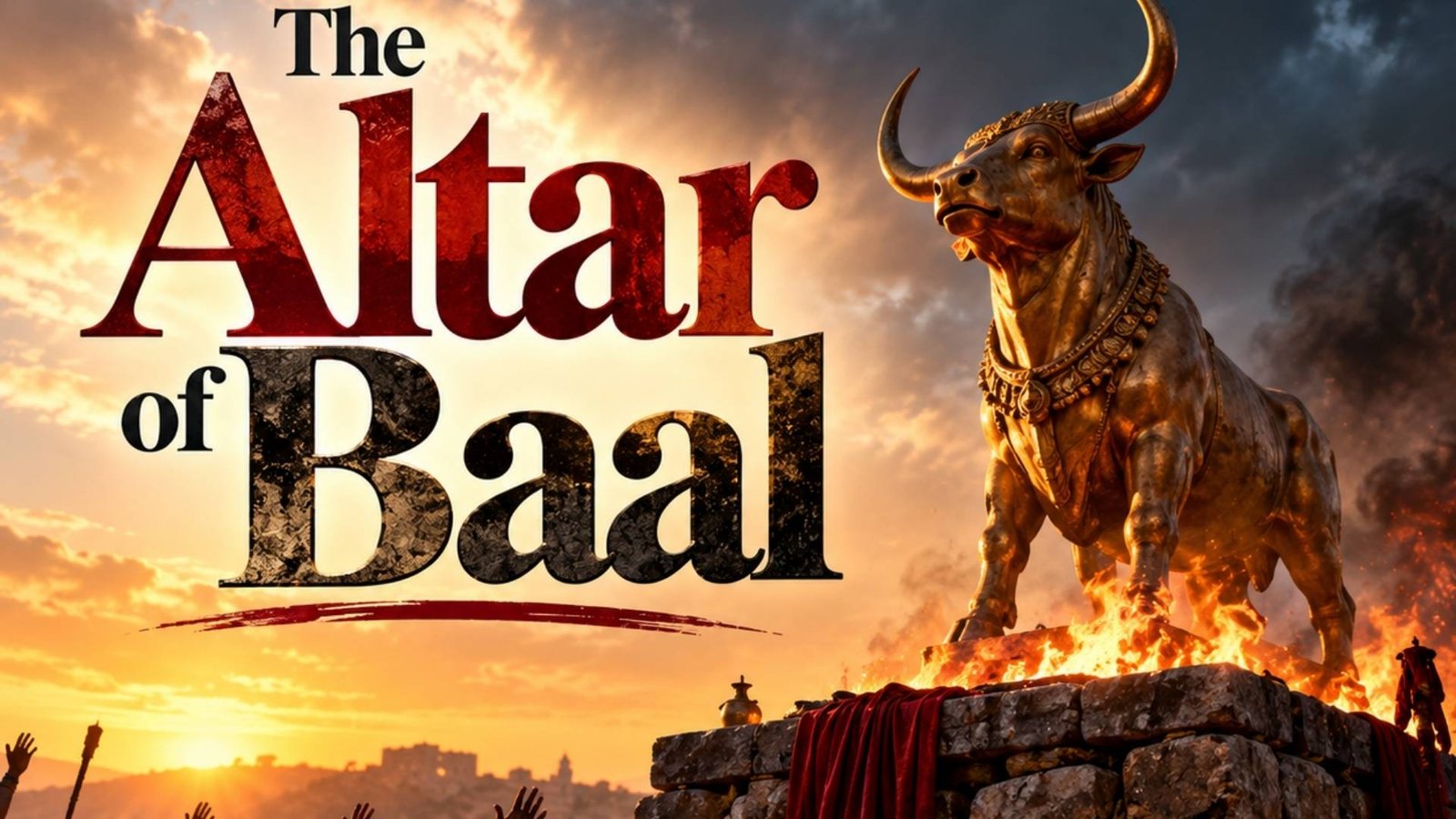
THE ALTAR OF BAAL: CONFRONTING FALSE WORSHIP AND THE BATTLE FOR SPIRITUAL AUTHORITY
Key Scriptures
- Judges 6:25–32
- 1 Kings 18:20–39
- Deuteronomy 12:29–31
- Exodus 20:3–5
- 2 Corinthians 6:14–18
Introduction: When Another Altar Occupies God’s Place
Throughout Scripture, an altar represents a place of sacrifice and worship. Altars appear in the lives of Noah, Abraham, Isaac, Jacob, Moses, and many others. They were associated with offerings, remembrance, covenant, and devotion to God. Yet the Bible also records altars built to false gods, revealing a conflict over whom people would worship and obey.
Among these was the altar of Baal.
The story of Baal’s altar is not merely an account of ancient religious practices. It reveals what happens when people who belong to the covenant community turn their devotion towards another god, when leadership legitimises false worship, and when the worship of the true God must be restored.
In the days of Elijah, Baal worship had become deeply embedded in Israel’s national life. Under King Ahab, the worship of Baal received royal support, while the prophet Elijah confronted the nation with a decisive question: “How long halt ye between two opinions?” (1 Kings 18:21).
The central issue was not simply the existence of a physical altar. It was the allegiance of the people.
An altar reveals more than what people offer; it points to the one to whom their worship is directed.
To understand the altar of Baal, we must examine its biblical history, the spiritual conflict surrounding it, and the lessons Scripture offers concerning idolatry, compromise, leadership, and the restoration of true worship.
1. Who Was Baal?
Baal was a prominent deity worshipped by various peoples in the ancient Levant. The name is commonly understood to mean “lord” or “master.” In the religious cultures surrounding ancient Israel, Baal was particularly associated with storms, rain, and agricultural fertility.
For a nation whose agriculture depended heavily on seasonal rainfall, the promise of fertility and productive land could make Baal worship attractive.
Israel, however, had been called to worship the Lord alone. The first commandment declared, “Thou shalt have no other gods before me” (Exodus 20:3).
The problem was therefore not simply that Baal was worshipped by other nations. It was that Israel repeatedly adopted the worship of foreign gods despite its covenant relationship with the Lord.
This conflict appears throughout the Old Testament. Judges 2:11–13 records that the Israelites did evil in the sight of the Lord and served the Baals. Their worship represented a departure from the God who had delivered them from Egypt and established them in the land.
The biblical concern was covenant unfaithfulness. Israel was not free to combine the worship of the Lord with devotion to other gods as though all forms of worship were interchangeable.
The story of Baal therefore begins with a question of allegiance: would Israel trust the Lord who had revealed Himself to them, or pursue the religious practices of the surrounding nations?
2. The Altar of Baal in the House of Gideon
One of the most striking accounts of Baal’s altar appears in Judges 6.
Israel had been oppressed by Midian because of its disobedience to God. When the Lord called Gideon to deliver His people, Gideon was instructed to tear down his father’s altar to Baal and cut down the Asherah pole beside it (Judges 6:25–26).
He was then to build an altar to the Lord and offer a sacrifice according to God’s instructions.
Notice the order: before Gideon led Israel into battle against Midian, he was commanded to confront the idolatry within his own household.
This is a significant feature of the narrative. Gideon’s first recorded assignment after receiving his commission was not to assemble an army or attack the enemy. It was to remove an altar associated with the worship of a false god.
The account does not establish that every personal difficulty is caused by an ancestral altar or that Christians must reproduce Gideon’s specific action through a modern ritual. Rather, it shows that Israel’s deliverance was connected to returning to the Lord and rejecting the idolatry that violated its covenant.
Gideon obeyed, but he carried out the task at night because he feared his family and the townspeople (Judges 6:27). When the men of the town discovered what had happened, they demanded his death. His father, Joash, challenged them to let Baal defend himself if Baal truly was a god (Judges 6:28–32).
The incident exposed the weakness of the idol’s supposed authority: the people were prepared to kill a man for destroying Baal’s altar, yet Baal himself could not demonstrate the power they attributed to him.
The spiritual lesson is profound. False worship can become so deeply established in a community that questioning it appears more offensive than the idolatry itself.
Before Gideon confronted Midian’s oppression, he had to obey God concerning the idolatry in his own household.
3. The Altar of Baal Under King Ahab
The conflict intensified during the reign of King Ahab.
First Kings 16:30–33 describes Ahab as doing evil in the sight of the Lord. He married Jezebel, the daughter of the king of the Sidonians, and served Baal. He built an altar for Baal in the temple of Baal he had established in Samaria.
This was more than a private act of religious preference. The worship of Baal had received royal endorsement.
Leadership matters because leaders influence what a community accepts, celebrates, funds, and practises. When a king promotes a form of worship that contradicts the covenant, the consequences extend beyond his personal life.
Israel’s struggle was no longer simply between the faithfulness of an individual and the temptation of a foreign religion. The nation’s leadership had helped institutionalise the competing worship.
The story reminds us that public acceptance does not make a practice right before God. Something can receive political approval, cultural popularity, or institutional support and still contradict the truth.
For Christians today, this principle calls for discernment in leadership, business, ministry, and public life. Influence carries responsibility. Leaders must not use their positions to legitimise what violates the values they are called to uphold.
However, we must apply the passage carefully. Modern political disagreements or unfamiliar religious practices should not automatically be labelled Baal worship. The biblical issue is idolatry and the replacement of the true God with another object of ultimate devotion.
4. Elijah and the Confrontation on Mount Carmel
The most famous confrontation involving Baal’s worship took place on Mount Carmel in 1 Kings 18.
After a prolonged drought, Elijah gathered the people of Israel and confronted the prophets of Baal. He asked them, “How long halt ye between two opinions?” He then declared that if the Lord was God, they should follow Him, but if Baal was god, they should follow Baal (1 Kings 18:21).
The issue was divided allegiance.
Elijah proposed that two bulls be prepared and placed on separate altars. The prophets of Baal would call on their god, while Elijah would call on the name of the Lord. The God who answered by fire would be revealed as God.
The prophets of Baal cried out, danced around their altar, and continued their efforts for much of the day. Yet there was no voice, no answer, and no response (1 Kings 18:26–29).
Elijah then repaired the altar of the Lord that had been broken down. He prepared the sacrifice and had water poured over it, making the scene even more striking. He prayed that God would answer so that the people would know the Lord was God and that He was turning their hearts back to Him (1 Kings 18:30–37).
Fire fell, and the people acknowledged the Lord.
The point of the event was not that a sufficiently intense religious performance could force a supernatural response. It was that the Lord revealed Himself in answer to Elijah’s prayer, exposing the inability of Baal to answer and calling Israel back to covenant faithfulness.
Elijah’s prayer was directed towards God’s glory and the restoration of the people’s allegiance.
The passage also challenges the idea that religious activity is necessarily evidence of divine approval. The prophets of Baal were active, emotional, and persistent, yet their efforts did not establish that their god was real.
Intensity is not the same as authority, and religious performance is not the same as divine approval.
5. The Broken Altar of the Lord: A Picture of Neglected Worship
Before Elijah’s sacrifice was prepared, Scripture says he repaired the altar of the Lord that had been broken down (1 Kings 18:30).
The text does not tell us exactly when or why the altar had been damaged. We should therefore avoid inventing a history for it. Nevertheless, within the narrative, its condition provides a clear contrast: Baal had received active worship, while the altar associated with the Lord needed to be repaired.
This contrast highlights the condition of Israel’s public allegiance.
The people had not necessarily forgotten the Lord’s name. Their problem was that their loyalty had become divided, and the worship of Baal had been given a place that belonged to God alone.
A similar danger can arise in Christian life when religious language remains but obedience declines. A person may speak about God while allowing money, status, pleasure, relationships, ambition, or the approval of others to become the controlling influence in their decisions.
Not every pursuit of money or success is idolatry. Work, business, family, and achievement can be good gifts. They become spiritually disordered when they take the place of God or demand the kind of ultimate loyalty that belongs to Him alone.
Repairing what has been neglected begins with repentance, renewed devotion, obedience to Scripture, and the restoration of worship that reflects the truth about God.
The practical question is not merely whether we attend church or speak about faith. It is whether our daily decisions reveal that God holds the central place in our lives.
6. What Does the Altar of Baal Teach Us About Spiritual Warfare?
The story of Baal’s altar is often used in Christian teaching about spiritual warfare. It certainly reveals a conflict involving worship, allegiance, false religion, and the rejection of God’s covenant.
Yet responsible interpretation requires us to distinguish the original biblical setting from modern applications.
In Judges 6, Gideon was commanded to destroy a specific altar because God was calling Israel away from idolatry. In 1 Kings 18, Elijah confronted Baal’s prophets to demonstrate the Lord’s supremacy and call the people back to Him.
These were particular events in Israel’s covenant history. They do not establish that every misfortune, illness, family problem, or business setback is caused by a physical altar or a hidden ancestral spiritual structure.
The New Testament directs Christians towards a different framework for spiritual warfare. Ephesians 6:10–18 calls believers to stand against the schemes of the devil through truth, righteousness, faith, salvation, the Word of God, and prayer.
First Corinthians 10:14 likewise instructs Christians to flee from idolatry.
Therefore, applying the lesson of Baal’s altar today begins with rejecting idolatry, remaining faithful to Christ, refusing practices that contradict biblical teaching, and resisting temptation. It also involves addressing practical problems with wisdom rather than attributing every difficulty to an unseen spiritual cause.
The story should produce discernment and faithfulness, not a life governed by fear of hidden altars.
7. The Christian Response: Christ, True Worship, and Undivided Allegiance
The central question at Mount Carmel was, “Who is God?” Elijah’s challenge required Israel to stop treating worship as a matter of divided loyalty.
For Christians, the New Testament places Jesus Christ at the centre of salvation and worship. Jesus declared that the Father seeks those who worship Him in spirit and truth (John 4:23–24).
This means that true worship cannot be reduced to a physical location, a religious object, or a particular ritual. It involves a right relationship with God expressed through faith, truth, obedience, and devotion.
Paul also warns believers against idolatry and explains that they cannot participate in the Lord’s table and the table of demons as though the two were compatible (1 Corinthians 10:14–22). His teaching concerns genuine spiritual allegiance, not permission to accuse people or objects of possessing hidden powers without biblical grounds.
The Christian response to the lesson of Baal’s altar is therefore clear: turn away from idolatry, examine competing loyalties, reject practices that contradict the Gospel, and give Christ the place that belongs to Him.
Where repentance is needed, repent. Where beliefs have been shaped by fear or misinformation, return to Scripture. Where habits have displaced devotion to God, rebuild a life of prayer, worship, obedience, and fellowship with other believers.
The answer to false worship is not fascination with darkness. It is faithfulness to the true God.
Conclusion: Who Occupies the Place of Worship?
The altar of Baal stands in Scripture as a powerful reminder of what happens when the worship of God is displaced by competing allegiances.
In Gideon’s household, the altar had to be confronted before Israel’s deliverance advanced. Under Ahab, Baal worship received royal support and threatened Israel’s covenant faithfulness. On Mount Carmel, Elijah called the people to make a decision, and God answered to reveal His supremacy and turn their hearts back to Him.
The message is not that every difficulty is evidence of a hidden altar. It is that God’s people must understand whom they worship, whose truth governs their lives, and where their deepest allegiance belongs.
An altar may be built of stone, but idolatry can also take root in the heart. Anything we elevate above God can begin to shape our decisions, control our affections, and compete for our obedience.
The call of Scripture remains the same: abandon divided allegiance and return to the Lord.
The greatest victory is not merely the destruction of an altar associated with false worship; it is the restoration of a heart wholly devoted to God.
Prayer
Heavenly Father, give us hearts that worship You in spirit and in truth. Expose every form of idolatry, compromise, and misplaced allegiance in our lives. Give us the courage to turn away from whatever contradicts Your Word and the wisdom to distinguish biblical truth from fear and speculation. Strengthen us to stand firm in Christ, live in obedience, and honour You in our homes, work, relationships, and service. May our lives reflect undivided devotion to You. In Jesus’ name, Amen.
Scriptures for Further Study
- Exodus 20:1–6 — The command to worship God alone.
- Judges 2:11–15 — Israel’s departure into idolatry.
- Judges 6:25–32 — Gideon destroys his father’s altar to Baal.
- 1 Kings 16:29–33 — Ahab promotes the worship of Baal.
- 1 Kings 18:20–39 — Elijah’s confrontation on Mount Carmel.
- John 4:19–24 — Worship in spirit and truth.
- 1 Corinthians 10:14–22 — Fleeing from idolatry.
- Ephesians 6:10–18 — The armour of God and spiritual warfare.