
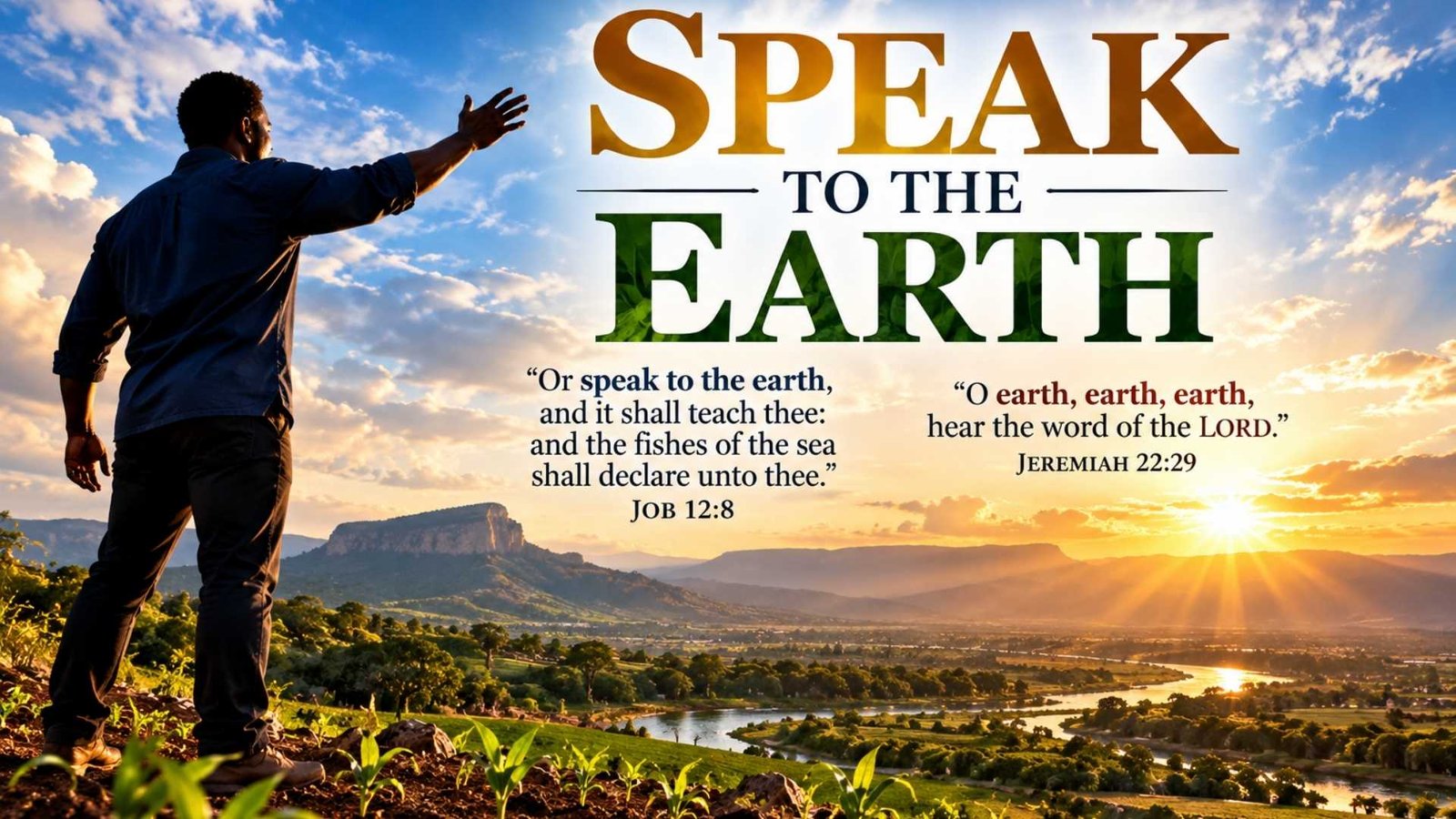
Speak to the Earth
The Spiritual Significance of the Earth as a Witness, a Resource, and an Instrument in God’s Purposes
Key Scriptures: Job 12:8; Jeremiah 22:29–30; Isaiah 1:2; Numbers 16:30–32
“Or speak to the earth, and it shall teach thee: and the fishes of the sea shall declare unto thee.” — Job 12:8 (KJV)
“ O earth, earth, earth, hear the word of the LORD.” — Jeremiah 22:29 (KJV)
There are moments in Scripture when God speaks to humanity through creation, and there are moments when the earth itself becomes the object of a prophetic declaration. The earth is not merely the ground upon which human beings walk. In the biblical narrative, it is God’s creation, the place where human history unfolds, the environment through which life is sustained, and sometimes the witness to the consequences of human actions.
Job 12:8 invites us to consider the earth as a teacher. Jeremiah 22:29 calls upon the earth to hear the word of the Lord. Together, these passages open a profound subject for biblical reflection: what does it mean to speak to the earth, and what can Scripture teach us about the relationship between God’s Word, the earth, and human destiny?
Before we explore this subject, we must make an important distinction. The Bible’s language about speaking to the earth is not a universal formula for controlling land, forcing circumstances to change, or guaranteeing prosperity. Each passage has its own context. Nevertheless, when read together, these scriptures reveal important principles concerning creation, divine authority, human responsibility, and the consequences of our actions.
The Earth Is Not Silent: It Has a Testimony
In Job 12, Job responds to his friends, who have assumed that they understand the reasons for his suffering. Their explanations are confident, but their understanding is incomplete.
Job directs their attention to the wisdom that can be observed throughout creation. In Job 12:7–10, he refers to animals, birds, the earth, and the fish of the sea. These creatures and elements of creation testify to a fundamental truth: the hand of the Lord is present in the life of creation.
The passage does not suggest that the earth speaks human language. Rather, creation itself provides evidence of God’s power, wisdom, and sustaining authority.
Psalm 19:1 expresses a similar principle: “The heavens declare the glory of God; and the firmament sheweth his handywork.”
Creation communicates through what it reveals. The changing seasons, the productivity of the soil, the dependence of living things upon water, and the intricate relationships that sustain life all invite us to consider the wisdom of the Creator.
The earth teaches us about dependence. A farmer may possess land, machinery, and knowledge, yet remains dependent upon conditions that cannot be controlled entirely. Human beings can cultivate the soil, but they cannot command every rainfall. They can develop technology, but they cannot make themselves independent of the natural systems that sustain life.
This is one of the first lessons of speaking to the earth: before we attempt to exercise authority over anything, we must learn from what God has already created.
The earth is not our creator, but its testimony points us toward the wisdom, power, and authority of the Creator.
“O Earth, Earth, Earth”: When God Calls Creation to Hear
Jeremiah 22:29 contains one of the Bible’s striking prophetic declarations:
“O earth, earth, earth, hear the word of the LORD.”
Why does Jeremiah address the earth in this manner?
The surrounding chapter provides the answer. Jeremiah is delivering a message of judgment concerning the kings of Judah, particularly the failure of the royal house to govern faithfully. The chapter confronts injustice, disobedience, and the consequences of rejecting God’s instruction.
In verse 30, Jeremiah pronounces a judgment concerning Coniah, also known as Jeconiah or Jehoiachin, declaring that he would be recorded as childless in the sense that none of his offspring would prosper on the throne of David and rule in Judah.
The passage is therefore not originally a general prayer for personal success or a command to the physical ground to release blessings. It is a prophetic declaration within a specific historical and covenantal setting.
Why, then, does Jeremiah call upon the earth to hear?
The language intensifies the seriousness of the message. The earth is addressed as though summoned to witness the word of the Lord. The declaration places the judgment within a larger setting than the immediate political circumstances of Judah.
Here we discover a significant biblical principle: when God speaks, His Word carries authority beyond the opinions, ambitions, and decisions of human beings.
Kings may occupy thrones, but they do not stand above God’s moral authority. Human institutions may appear permanent, but they remain accountable to the One who rules over history.
Jeremiah’s declaration reminds us that divine authority is not limited by the boundaries of human power.
The repeated phrase “earth, earth, earth” also communicates urgency. The prophet is not treating God’s message as a casual observation. He is announcing something that demands attention.
For today’s reader, the application is not to repeat the phrase as a magical formula. It is to recognise the seriousness of God’s Word and the responsibility of those who hear it.
The Earth as a Witness to Human Actions
The idea of creation serving as a witness appears in several other passages.
In Deuteronomy 30:19, Moses calls heaven and earth to witness that he has set before Israel life and death, blessing and curse. Joshua 24:26–27 similarly records Joshua establishing a stone as a witness to Israel’s covenant commitment, declaring that it had heard the words spoken.
These passages use witness language to emphasise accountability.
The earth does not need to function as a conscious observer for the imagery to carry meaning. The point is that human choices take place within God’s created order and under His authority. What people do matters, and their decisions have consequences.
Consider the biblical account of Cain and Abel in Genesis 4. After Cain murders Abel, God declares that Abel’s blood is crying to Him from the ground.
The ground becomes part of the imagery through which the seriousness of innocent bloodshed is exposed. The violence Cain attempted to conceal is not hidden from God.
Genesis 4:10–12 connects the blood crying from the ground with a judgment affecting Cain’s relationship to the soil. The ground that received his brother’s blood would no longer yield its strength to him as before.
This account reveals a sobering principle: the earth that sustains human life can also become part of the biblical testimony against human wrongdoing.
In Isaiah 1:2, God calls heaven and earth to hear as He confronts Israel’s rebellion. The prophet presents creation as a witness while exposing the spiritual and moral failure of God’s people.
These passages challenge the assumption that human actions are isolated events without lasting consequences.
Injustice affects families and communities. Bloodshed leaves scars across generations. Irresponsible use of natural resources damages the environment that supports human life.
The earth is not merely a setting for human ambition. It is part of the created order over which humanity has been entrusted with responsibility.
When the Earth Opens: The Authority of God Over Creation
Numbers 16 provides another remarkable biblical account involving the earth.
Korah, Dathan, Abiram, and their associates challenge the leadership established by God during Israel’s wilderness journey. The dispute is not presented as an ordinary disagreement; it develops into a serious rebellion against the order God had established.
Moses announces a sign by which the people would recognise the Lord’s judgment. Numbers 16:30–32 records the ground opening and swallowing those associated with the rebellion.
This is a specific act of divine judgment within Israel’s wilderness history. It should not be treated as a pattern by which believers can command the ground to swallow enemies or interpret every disaster as evidence of divine punishment.
Nevertheless, the account reveals something important about biblical understandings of creation: the earth remains under God’s authority.
Human beings may build cities, establish borders, cultivate fields, and construct elaborate systems of power. Yet we are never sovereign over creation in the way God is sovereign over it.
The story of Korah also warns against using spiritual language to justify personal ambition. The desire to speak with authority does not automatically mean that a person has been authorised by God to do so.
Before declaring judgment over others, we must examine our own hearts, motives, and relationship with God’s Word.
The authority of God is real, but it is not a tool for human pride, revenge, or the manipulation of others.
The Earth and the Principle of Sowing and Reaping
Another important dimension of this subject appears in Genesis 8:22:
“While the earth remaineth, seedtime and harvest, and cold and heat, and summer and winter, and day and night shall not cease.”
After the flood, God establishes this assurance concerning the continuing rhythms of creation.
The verse describes the reliability of the created order. Human life depends upon patterns of work, planting, growth, and harvest. These processes do not remove uncertainty, but they provide a foundation for human responsibility.
Galatians 6:7–9 develops the principle of sowing and reaping in a moral and spiritual context. Paul warns that a person reaps what they sow and encourages believers not to grow weary in doing good.
The connection is not that every physical harvest reveals the moral condition of the farmer. Nor does Scripture teach that every financial loss results from wrongdoing. Rather, the language of sowing and reaping illustrates that actions have consequences.
A person who consistently sows dishonesty may eventually destroy trust. A leader who sows injustice may produce resentment and instability. Someone who sows diligence, wisdom, and generosity may cultivate conditions in which others can flourish.
This principle can also inform how we relate to the physical earth. The soil cannot be exhausted indefinitely without consequences. Water cannot be polluted without affecting life. Natural resources require stewardship, not merely consumption.
Genesis 2:15 describes humanity’s responsibility to work and keep the garden. The biblical mandate is therefore not simply to extract value from creation, but to cultivate and care for what God has entrusted to humanity.
When we speak about the earth, we must also ask how we are treating it.
Are we cultivating what has been entrusted to us? Are we destroying resources through negligence? Are we creating conditions that will support future generations?
The earth is a resource, but it is also a responsibility.
Speaking to the Earth: A Biblical Principle or a Spiritual Formula?
Some believers use the phrase “speak to the earth” as a prayer expression, asking God to bring forth resources, opportunities, or the fulfilment of His purposes.
There is nothing inherently wrong with praying about land, provision, agriculture, business, or the practical circumstances of life. Scripture contains examples of God providing for His people through material resources and the created world.
However, we must distinguish personal prayer language from the original meaning of a biblical passage.
Jeremiah 22:29 is a prophetic call for the earth to hear God’s word in the context of judgment upon Judah’s royal house. Job 12:8 points to creation as a teacher. Neither passage directly establishes a universal formula by which a person can speak words over the ground and guarantee a particular result.
The Bible does show that God sometimes commands natural elements to act in extraordinary ways. Jesus calms a storm in Mark 4:35–41. In Matthew 21:18–22, He speaks to a fig tree within a particular episode of teaching and judgment. In Joshua 10:12–14, the sun and moon are addressed during a unique event in Israel’s history.
These are distinct narratives, each with its own purpose. They do not establish that every believer can reproduce every biblical event simply by repeating its words.
Faith is not the power to control God. Prayer is not a mechanism for compelling creation to obey our personal ambitions.
A sound biblical approach is to bring our needs before God, trust His wisdom, work responsibly, and remain open to His will.
If you are praying for a business, seek God’s guidance, but also study the market, understand your customers, manage your finances, and serve people honestly.
If you are praying over land, ask God for wisdom and provision, but also consider its suitability, legal ownership, soil quality, access to water, and responsible use.
If you are praying for a new season, trust God without assuming that every difficulty is evidence of spiritual opposition.
Faith does not make responsibility unnecessary; it gives responsibility a deeper foundation.
The Earth Belongs to the Lord
Psalm 24:1 declares:
“The earth is the LORD’S, and the fulness thereof; the world, and they that dwell therein.”
This verse establishes the fundamental biblical perspective from which the entire subject should be approached.
The earth belongs to God.
Human ownership, possession, and stewardship operate within a larger reality: everything ultimately belongs to the Creator. Our resources are entrusted to us for a time, and our use of them carries moral responsibility.
This perspective challenges greed and arrogance. It reminds wealthy people that possessions do not make them absolute owners before God. It reminds leaders that authority is entrusted, not unlimited. It reminds every person that the material world is not merely an object to be exploited for personal gain.
The earth can supply food, shelter, materials, and opportunities for productive work. But its resources must be handled with wisdom and justice.
When we acknowledge that the earth belongs to the Lord, we learn to approach it with gratitude, stewardship, and accountability.
Conclusion: Let the Word of God Govern Your Relationship With the Earth
To speak about the earth from a biblical perspective is to recognise more than its physical properties. It is to consider the Creator who made it, the human responsibility associated with it, and the spiritual lessons Scripture draws from it.
Job 12:8 reminds us that creation can teach us about God’s wisdom and sustaining power. Jeremiah 22:29 declares the seriousness of the Lord’s Word within a prophetic message of judgment. Genesis 4 shows the ground receiving the testimony of innocent blood, while Numbers 16 reveals a unique act of divine judgment involving the earth. Genesis 8:22 reminds us of the continuing rhythms that sustain life, and Psalm 24:1 establishes God’s ownership over creation.
Together, these passages call us to humility, accountability, and responsible action.
Do not treat the earth as though it exists independently of God. Do not use Scripture to turn prayer into a formula for controlling your circumstances. Instead, learn from creation, respect the authority of God’s Word, and faithfully manage the resources entrusted to you.
The earth beneath your feet is part of God’s creation. The resources within it can serve human needs. The choices made upon it can bring benefit or harm. And throughout Scripture, creation directs our attention beyond itself to the God who made it.
Before you command the earth to produce, learn what God has said about it. Before you seek its resources, understand your responsibility toward them. And before you speak in the name of God, ensure that your words are governed by His truth.
A Prayer
Heavenly Father, You are the Creator of heaven and earth, and all creation belongs to You. Give me wisdom to understand Your Word, humility to recognise Your authority, and discipline to manage the resources You have entrusted to me. Teach me to work faithfully, cultivate what is good, reject injustice, and use the earth responsibly. May my prayers be shaped by Your truth, my decisions guided by Your wisdom, and my life directed toward Your purposes. In Jesus’ name, Amen.
Scriptures for Further Study
- Job 12:7–10 — Creation testifies to God’s wisdom and sustaining power.
- Jeremiah 22:24–30 — A prophetic declaration concerning Judah’s royal house.
- Genesis 1:26–28 — Humanity’s responsibility toward creation.
- Genesis 2:15 — Working and keeping the garden.
- Genesis 4:8–12 — Abel’s blood and the ground.
- Genesis 8:20–22 — The continuing rhythms of creation.
- Numbers 16:23–35 — The judgment involving Korah and his associates.
- Deuteronomy 30:19 — Heaven and earth as witnesses.
- Psalm 19:1–4 — The heavens declare God’s glory.
- Psalm 24:1 — The earth belongs to the Lord.
- Isaiah 1:2 — Heaven and earth called as witnesses.
- Galatians 6:7–10 — Sowing, reaping, and perseverance in doing good.










