
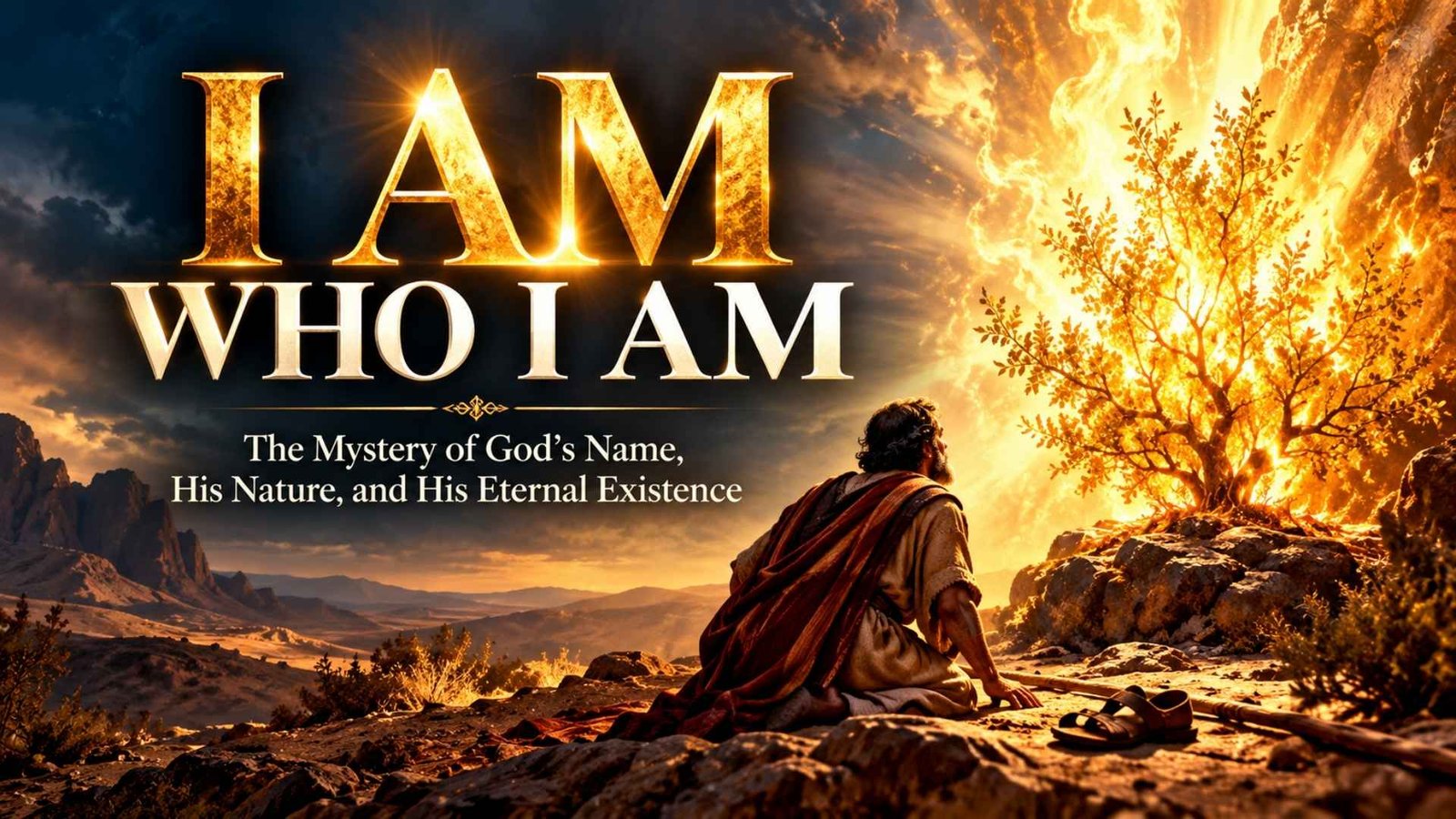
I AM WHO I AM: The Mystery of God’s Name, His Nature, and His Eternal Existence
Key Scriptures
- Exodus 3:13–15
- John 8:56–59
- Revelation 1:8
- Isaiah 46:9–10
Introduction: The Name That Reveals the Unchanging God
There are names that describe what someone does, titles that identify a person’s position, and names that reveal something about identity. But in Exodus 3, Moses encounters a revelation of God that reaches beyond the ordinary limitations of human description.
When Moses asks God what he should tell the Israelites if they inquire about the name of the One who sent him, God answers:
“I AM THAT I AM.” — Exodus 3:14, KJV
This is one of the most profound declarations in Scripture. God does not introduce Himself by referring to a superior authority, explaining His origin, or identifying a power greater than Himself. He reveals Himself through a declaration of existence.
Who gave God His existence? Nobody.
Who sustains God? He is not dependent on another being for His existence.
Who was present before creation? God.
Who will remain when the present order of creation has passed away? God.
Before there was a world to govern, there was God. Before there was a throne, there was a King. Before there was time as we experience it, God already was.
The declaration I AM WHO I AM therefore directs our attention to the eternal identity, sovereignty, and faithfulness of God. It is not merely a name to be repeated in prayer; it is a revelation that confronts our understanding of existence itself.
Yet this revelation becomes even more profound when we follow its development through Scripture, from the burning bush in Exodus to the extraordinary declarations of Jesus Christ in the Gospel of John.
God does not become God through creation, recognition, or authority. Everything that exists depends upon Him, while He does not depend upon anything outside Himself for His existence.
1. The Burning Bush: When God Reveals Himself in an Unexpected Place
Scripture: Exodus 3:1–12
Moses was tending the flock of Jethro when he encountered a bush that burned without being consumed. What appeared to be an ordinary wilderness scene became the setting for a divine encounter.
God called Moses from the bush and instructed him to remove his sandals because the ground on which he stood was holy.
The location was significant not because the wilderness possessed an inherent holiness, but because God had made His presence known there.
Moses had spent years away from Egypt. The man who had once lived within Pharaoh’s household was now a shepherd. His earlier attempt to intervene in the suffering of his people had ended in the death of an Egyptian and his own flight from Egypt (Exodus 2:11–15).
Now God called him to return.
Moses immediately raised a question about his own adequacy: “Who am I, that I should go unto Pharaoh?” (Exodus 3:11).
God’s response is instructive. He did not begin by giving Moses a list of his strengths. He promised, “Certainly I will be with thee” (Exodus 3:12).
The assurance of God’s presence came before Moses received the revelation of God’s name.
This sequence matters. Moses’ mission would not succeed because he possessed sufficient personal power to confront Pharaoh. He was being sent by the God who would accompany him.
There are moments when the most important question is not, Who am I in comparison with the challenge before me? but, Who is the God who has called me to obey?
The burning bush introduces Moses to a God whose presence transforms an ordinary place into the setting of divine revelation. It also establishes the foundation of his assignment: the authority behind the mission belongs to God.
2. I AM WHO I AM: The Mystery of Divine Existence
Scripture: Exodus 3:13–15
When Moses asks what name he should give the Israelites, God declares, “I AM THAT I AM.”
The Hebrew expression is Ehyeh Asher Ehyeh. It can be understood as “I AM WHO I AM” or, depending on how the Hebrew expression is rendered in context, “I WILL BE WHAT I WILL BE.”
The declaration communicates God’s identity in a way that cannot be reduced to a human title or description.
In theological terms, it points toward God’s self-existence: He does not receive His being from another source. Unlike created beings, God is not dependent upon something outside Himself to exist.
The universe depends on conditions and causes beyond itself. Human beings are born, grow, age, and die. Nations rise and fall. Institutions are established and eventually disappear.
God, however, does not derive His identity from the changing circumstances of creation.
This is why the revelation of His name is so powerful. Moses is being sent to confront a ruler whose authority appears formidable, but Pharaoh is not the ultimate authority over Israel’s destiny.
The God who sends Moses is not a deity whose existence depends on the success of Israel, the strength of Moses, or the cooperation of Egypt.
He is the God who is.
Yet the name must also be understood within the immediate context of Exodus. God is revealing Himself to a people who have suffered under oppression and reminding them of His covenant faithfulness. Exodus 3:6 identifies Him as the God of Abraham, Isaac, and Jacob, while Exodus 3:15 connects His name with His enduring relationship with Israel.
The revelation therefore combines profound theological truth with a direct promise of divine involvement in history.
God is not merely an abstract principle of existence. He is the God who sees the suffering of His people, hears their cries, remembers His covenant, and acts according to His purposes (Exodus 3:7–10).
The God who exists independently of creation is also the God who enters human history to accomplish His purposes.
3. Before Everything Was, I AM
Scripture: Psalm 90:1–2; Isaiah 46:9–10
Psalm 90:2 declares that before the mountains were brought forth and before God formed the earth and the world, He is God from everlasting to everlasting.
This places God beyond the limits that define created existence.
Everything in creation has a beginning. The earth has a history. Human civilisation has a history. The stars and galaxies belong to the created order. Even the systems through which people organise society are temporary.
God is not one more being within this chain of existence. He is the Creator.
Isaiah 46:9–10 reinforces this truth by presenting God as the One who declares the end from the beginning and whose purposes stand.
His knowledge and authority are not limited by the uncertainty that governs human experience. We make decisions without knowing every consequence. We enter seasons whose outcomes remain hidden. We may understand the present while remaining unable to predict what tomorrow will bring.
God is not subject to those limitations.
However, this does not mean that human beings possess God’s knowledge merely because they know His name. Nor does the declaration I AM give believers permission to make every personal desire a divine decree.
It reveals God’s unique identity and calls us to trust Him.
The future may be uncertain to us, but it is not outside God’s knowledge. Our responsibility is to seek His wisdom, act faithfully, and entrust the things we cannot control to His sovereignty.
The God who was present before creation will not be displaced by the changing circumstances of the world.
4. The I AM of Exodus and the I AM Sayings of Jesus
Scripture: John 8:48–59
The Gospel of John develops one of the most significant connections between the identity of God and the person of Jesus Christ.
Throughout the Gospel, Jesus uses a series of I am declarations to reveal aspects of His identity and mission.
He declares, “I am the bread of life” (John 6:35), “I am the light of the world” (John 8:12), “I am the good shepherd” (John 10:11), and “I am the way, the truth, and the life” (John 14:6).
These declarations reveal who He is and what He accomplishes for those who believe in Him.
But John 8:58 stands apart:
“Before Abraham was, I am.”
Jesus does not merely say that He existed before Abraham. He contrasts Abraham’s coming into existence with His own declaration, “I am.”
The response of His hearers is significant. John 8:59 records that they took up stones to throw at Him.
Within the narrative, Jesus’ statement is understood as a profound claim that goes beyond ordinary human existence. The passage contributes to John’s wider presentation of Jesus as the eternal Word who was with God and was God, through whom all things were made (John 1:1–3).
Christians have historically understood these passages as central to the doctrine of Christ’s deity.
Nevertheless, careful interpretation requires us to recognise that the expression I am does not carry precisely the same significance in every sentence where it appears. Its meaning must be determined by context.
In John 8:58, the contrast with Abraham and the reaction of the audience make the statement especially significant.
Jesus is not simply claiming to be a teacher with an ancient spiritual heritage. John presents Him as the One whose identity reaches beyond the limits of created history.
This is one of the central revelations of the Gospel: the eternal Word entered human history, took on flesh, and made the Father known (John 1:14–18).
5. Jesus Christ: The Visible Revelation of the Invisible God
Scripture: John 1:1–18; Colossians 1:15–20
If the God revealed to Moses is the eternal Creator, how should we understand Jesus’ place in relation to Him?
The New Testament answers this question through several interconnected declarations.
John 1:1 states that the Word was in the beginning, that the Word was with God, and that the Word was God. Verse 14 then declares that the Word became flesh and dwelt among humanity.
Colossians 1:15–17 describes Christ as the image of the invisible God and declares that all things were created through Him and for Him. It further states that He is before all things and that all things hold together in Him.
These passages establish that Christ is not presented as a created being who later attained divine status. He is presented as existing before creation and participating in the divine work of creation.
The doctrine of the Trinity provides the historic Christian framework for understanding these truths: there is one God, eternally existing as Father, Son, and Holy Spirit. The Son is distinct from the Father, yet shares the divine nature.
The Father is not the Son, and the Son is not the Holy Spirit. Yet Christians confess one God, not three independent gods.
This distinction matters because Jesus’ declarations cannot be understood accurately by simply collapsing the Father and the Son into the same person or by treating Jesus as a merely human representative of God.
John’s Gospel holds together both distinction and unity. Jesus speaks to the Father, is sent by the Father, and reveals the Father; yet the Gospel also attributes divine identity and glory to Him.
The revelation of I AM reaches a remarkable point here. The eternal God has made Himself known through the incarnate Son, Jesus Christ.
In Him, divine revelation is not merely a message delivered from heaven. It is the personal presence of the Son within human history.
6. I AM Is Not a Formula for Human Self-Deification
Scripture: John 15:1–5; 1 Corinthians 15:10
There is an important distinction between God’s declaration, I AM WHO I AM, and a human being declaring, “I am who I am.”
In everyday language, a person may use that expression to communicate identity, individuality, or self-acceptance. Such a statement is not inherently wrong. People should understand their identity and avoid allowing every criticism to determine their sense of worth.
However, the theological significance of Exodus 3:14 belongs uniquely to God.
God is self-existent. We are created.
God does not depend on creation for His being. We depend on Him for life and breath.
God’s identity is not conferred by another authority. Our identity is shaped by our created nature, our relationships, our actions, and, for those who are in Christ, our redemption and adoption into God’s family.
This distinction protects Christian teaching from confusing human dignity with divine independence.
John 15:5 records Jesus saying that apart from Him, His disciples can do nothing. Paul similarly declares in 1 Corinthians 15:10 that his ministry is the result of God’s grace working in him.
Neither passage teaches that believers lack value or responsibility. Rather, both show that Christian fruitfulness depends upon God.
A Christian can possess confidence without pride, accept personal responsibility without self-worship, and pursue excellence without imagining that human ability is independent of divine grace.
Our dignity comes from being created in God’s image; our spiritual fruitfulness comes from abiding in Christ.
The purpose of understanding God’s name is not to make ourselves the centre of existence. It is to recognise the One upon whom our existence depends.
7. The God Who Is: A Foundation for Faith in Changing Seasons
Scripture: Malachi 3:6; Hebrews 13:8
Human life is marked by change.
Relationships change. Economic conditions change. Careers develop in unexpected directions. Health, opportunities, and personal circumstances may fluctuate. Even our understanding of ourselves can change as we mature.
The revelation of God’s enduring nature offers believers a foundation for trust amid these uncertainties.
Malachi 3:6 records God’s declaration that He does not change. In its immediate context, this statement relates to God’s faithfulness to His covenant purposes toward Israel.
Hebrews 13:8 declares that Jesus Christ is the same yesterday, today, and forever.
These passages do not mean that God always acts in the same way in every circumstance or that every biblical promise applies identically to every believer. Scripture reveals different stages of God’s dealings with humanity, and its promises must be interpreted in context.
What remains constant is God’s character: His holiness, faithfulness, truth, justice, and mercy.
This gives Christians reason to trust Him even when they cannot predict how a situation will unfold.
When opportunities disappear, God has not ceased to be God. When prayers are answered differently from what we expected, His character has not become unreliable. When we face correction, His holiness remains good. When we repent, His mercy remains grounded in His revealed character and the work of Christ.
The declaration I AM is therefore not an invitation to presume upon God. It is an invitation to trust the One who remains faithful to Himself and His purposes.
Our circumstances may change, but the foundation of our hope does not rest on circumstances alone.
8. I AM WHO I AM: The Revelation That Demands a Response
Scripture: Exodus 3:14–15; John 20:28–31
The revelation of God’s name is not merely an intellectual puzzle. It calls for a response.
When God revealed Himself to Moses, He also commissioned him to return to Egypt and lead Israel out of bondage. The encounter led to obedience and a mission.
In the Gospel of John, the revelation of Jesus’ identity similarly calls people to faith. John 20:31 explains that the signs recorded in the Gospel were written so that readers might believe that Jesus is the Christ, the Son of God, and that through believing they may have life in His name.
The purpose of revelation is therefore not simply to increase our knowledge of spiritual language. It is to bring us into a right response to God.
We are called to worship Him because He is worthy. We are called to trust Him because He is faithful. We are called to obey Him because He is Lord. And through Jesus Christ, we are invited into reconciliation with the God who created us.
The God who revealed Himself at the burning bush is not waiting for humanity to give Him an identity. He reveals Himself so that humanity may know Him.
And the Son who declared His pre-existence before Abraham calls us not merely to admire His words, but to believe in Him.
Conclusion: Before the Beginning, God Was
Before Moses stood before Pharaoh, God was.
Before Abraham entered the biblical story, God was.
Before the foundations of the world were established, God was.
The declaration I AM WHO I AM confronts the limits of human existence and directs our attention to the eternal God. He is not sustained by creation, defined by human approval, or threatened by the rise and fall of earthly powers.
Yet the wonder of the biblical revelation is that this eternal God has made Himself known. He called Moses, acted in Israel’s history, and, according to the New Testament, revealed Himself decisively through Jesus Christ.
The Gospel does not invite us to become self-existent beings. It invites us to know the God upon whom our existence depends and to receive life through His Son.
Our confidence, therefore, is not that we can independently declare our own destiny into existence. It is that the God who is eternally faithful has revealed His character and offered redemption through Jesus Christ.
God does not need creation to establish His existence; creation needs God for its existence.
And because He is the eternal God, our response is to worship Him, trust His Word, walk in obedience, and build our lives upon the truth He has revealed.
Prayer
Eternal Father, You are the God who was before the foundations of the world and who remains faithful throughout every generation. Open my understanding to know You more deeply through Your Word and through Jesus Christ.
Teach me to trust Your character when my circumstances change. Deliver me from pride, self-sufficiency, and the desire to live independently of Your wisdom. Help me to understand my identity as Your creation and, through faith in Christ, to walk in the grace and purpose You have given me.
May my life bring honour to Your name. Let my confidence rest not in my own strength but in Your faithfulness, and teach me to remain obedient to You in every season.
In the name of Jesus Christ, Amen.
Scriptures for Further Study
- Exodus 3:1–15 — God’s revelation to Moses at the burning bush.
- Deuteronomy 6:4–5 — The oneness of God and the call to love Him.
- Psalm 90:1–2 — God from everlasting to everlasting.
- Isaiah 46:9–10 — God’s sovereignty and enduring purposes.
- John 1:1–18 — The eternal Word becomes flesh.
- John 8:48–59 — Jesus’ declaration before Abraham.
- John 14:6–11 — Jesus reveals the Father.
- John 15:1–8 — Abiding in Christ.
- Colossians 1:15–20 — The supremacy of Christ.
- Hebrews 13:8 — The unchanging Christ.










