
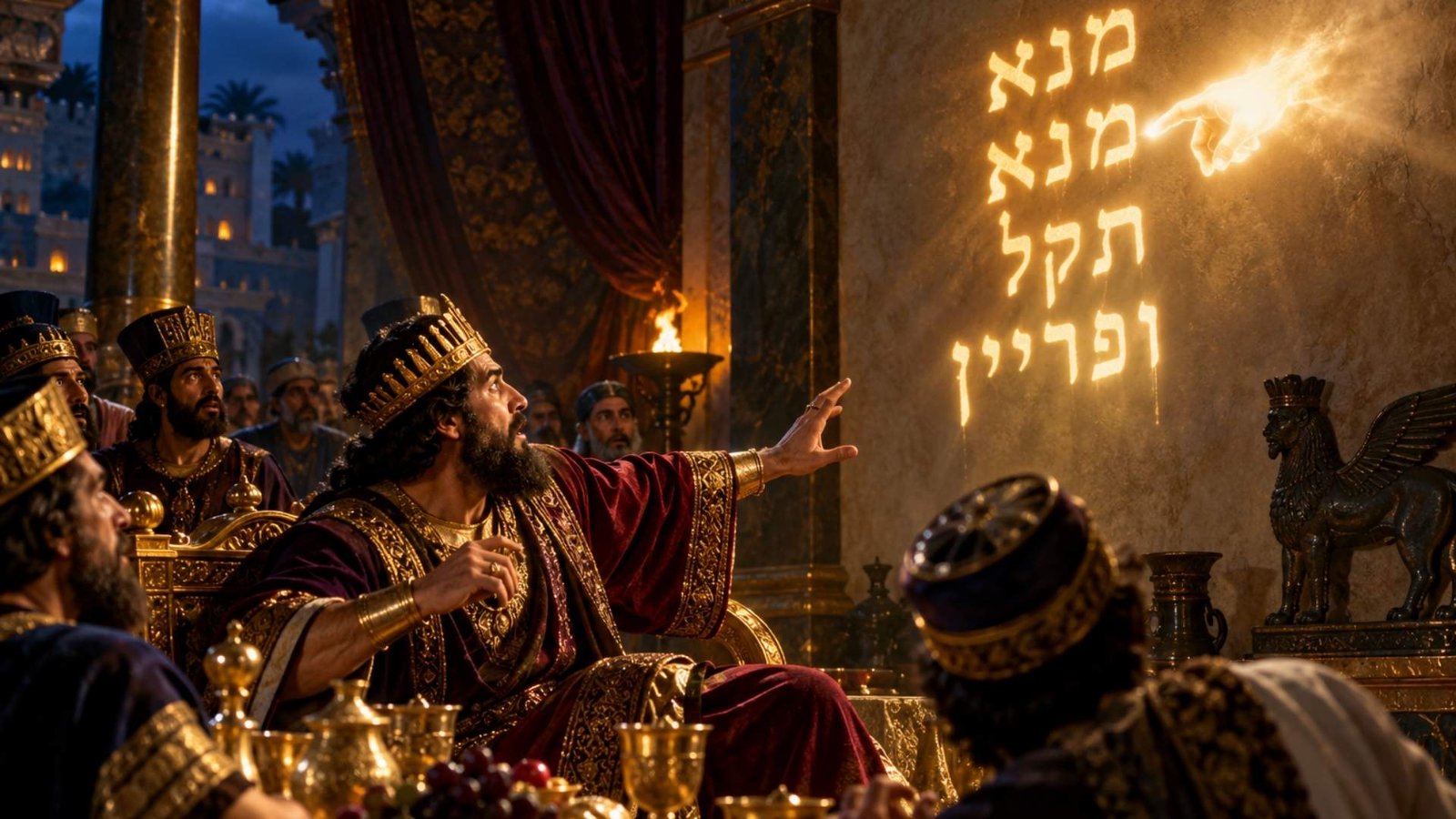
MENE, MENE, TEKEL, UPHARSIN: When Heaven Weighs a Kingdom
Key Scriptures
-
Daniel 5:1–31
-
Daniel 2:20–21
-
Proverbs 16:18
-
Hebrews 4:13
Introduction: The Handwriting That Interrupted a Feast
There are moments when a person may be celebrating on earth while a verdict has already been issued in heaven. The music is playing, the tables are full, the guests are rejoicing, and everything appears to be under control. Yet, beneath the appearance of success, an account is being examined, a season is reaching its conclusion, and the authority upon which everything stands is being challenged.
This is the atmosphere surrounding one of the most remarkable encounters in the Book of Daniel. King Belshazzar was hosting a great feast when a mysterious hand appeared and wrote words on the plaster of the palace wall: Mene, Mene, Tekel, Upharsin.
The king was terrified. His wise men could not interpret the writing, and the celebration was interrupted by a message that exposed the spiritual condition of his kingdom.
Daniel was eventually summoned to interpret the words. His explanation revealed something far greater than a prediction of political defeat. It was a divine judgment against a king who had exalted himself, dishonoured what was sacred, and failed to learn from the history of those who ruled before him.
The story presents a sobering spiritual reality: human authority may command a kingdom, but it cannot overrule the judgment of God.
Mene, Mene, Tekel, Upharsin is not merely a mysterious biblical phrase. It is a revelation of divine accountability, the limits of human pride, and the certainty that earthly power remains answerable to the God who rules over all.
1. The Feast of Belshazzar: When Prosperity Conceals Spiritual Danger
Scripture: Daniel 5:1–4
Belshazzar, king of Babylon, organised a great feast for a thousand of his nobles. In the midst of the celebration, he commanded that the gold and silver vessels taken from the temple in Jerusalem be brought into the banquet hall.
These vessels had been carried away during the Babylonian conquest of Jerusalem. They were not ordinary drinking utensils; they had been associated with the worship of the God of Israel in His temple.
Belshazzar used them during his feast, drinking wine with his nobles and praising their gods of gold, silver, bronze, iron, wood, and stone.
The issue was not simply that a king was holding a party. It was that he used his position and resources to treat sacred things with contempt while glorifying idols.
His feast revealed the condition of his heart. He possessed wealth, influence, political authority, and access to the treasures of a conquered nation, but he failed to recognise that his power was not absolute.
This is an important distinction in the life of faith: having the resources to do something does not automatically make it right to do it.
A person can be successful in business, influential in society, celebrated in ministry, or powerful in government and still be spiritually careless. External prosperity does not necessarily indicate divine approval.
Belshazzar’s palace was full of celebration, but the king was approaching a moment of accountability.
A person may have enough power to organise a feast, yet not enough wisdom to recognise that the season is about to change.
For Christians, the lesson is not to become suspicious of every moment of celebration or success. Rather, it is to remain humble, honour God, and recognise that blessings and positions of influence carry responsibilities.
2. The Sacred Vessels: When What Belongs to God Is Treated as Common
Scripture: Daniel 5:2–4; 1 Corinthians 6:19–20
Belshazzar’s actions were particularly serious because he deliberately brought the temple vessels into an environment of idolatrous celebration.
The vessels had been removed from Jerusalem during a period of national judgment. Their presence in Babylon testified to the defeat of Judah and the apparent triumph of the Babylonian Empire. Yet their history did not mean that Babylon’s gods had defeated the God of Israel.
The Lord had permitted Jerusalem to fall because of the circumstances of His people’s covenant disobedience, as the wider biblical narrative explains. Babylon’s temporary success did not place the empire beyond God’s authority.
Belshazzar failed to understand this distinction. He treated what was sacred as though it could be used to magnify his own greatness.
This principle reaches beyond physical objects. Scripture repeatedly teaches believers to honour God with their bodies, resources, gifts, relationships, and responsibilities.
Paul reminds the Corinthians that they are not their own, because they were bought with a price, and therefore should glorify God in their bodies (1 Corinthians 6:19–20).
Our gifts are not merely instruments for personal advancement. Our influence is not simply a platform for self-promotion. Our resources are not an excuse to forget the One to whom we are accountable.
In business, this means refusing to sacrifice integrity for profit. In ministry, it means refusing to exploit spiritual gifts for personal recognition. In leadership, it means understanding that authority is a trust rather than an entitlement.
What God entrusts to us must never become an instrument for dishonouring Him.
Belshazzar’s failure reminds us that the manner in which we handle what has been entrusted to us matters just as much as the privilege of possessing it.
3. The Handwriting on the Wall: When Heaven Interrupts Human Confidence
Scripture: Daniel 5:5–9
Suddenly, the fingers of a human hand appeared and wrote on the plaster of the palace wall, near the lampstand. The king watched the hand as it wrote.
His countenance changed, his thoughts troubled him, his limbs weakened, and his knees knocked together.
The man who had commanded a great feast could not command his own peace. The king whose word carried authority throughout his court was unable to explain the message confronting him.
He summoned his wise men and promised rewards to whoever could read and interpret the writing. Yet none of them could provide the answer.
The scene reveals a limit to human knowledge. There are circumstances in which wealth cannot purchase understanding, influence cannot produce wisdom, and earthly authority cannot silence the questions that confront the conscience.
However, the account should not be reduced to the idea that every unexplained event is a supernatural warning. Daniel 5 describes a specific event in biblical history, with a particular message and interpretation given by Daniel.
The spiritual lesson is that human confidence is never a substitute for wisdom before God.
A person may have an impressive reputation and still lack discernment. An institution may possess sophisticated systems and still fail to recognise its deeper weaknesses. A leader may surround himself with advisers and still need truth that none of them can provide.
The handwriting on the wall interrupted the celebration because it introduced a reality that the king could neither control nor negotiate.
Sometimes the most important question is not how much we have achieved, but whether we are prepared to give an account of how we have lived.
4. Daniel’s Rebuke: You Knew the History, but You Did Not Learn the Lesson
Scripture: Daniel 5:18–23
When Daniel appeared before the king, he did not immediately rush to interpret the writing. He first confronted Belshazzar with the history of Nebuchadnezzar, the former Babylonian king.
Nebuchadnezzar had received extraordinary authority and greatness. Yet his pride led to humiliation until he acknowledged that the Most High God rules over the kingdoms of humanity and gives them to whomever He wills (Daniel 5:18–21).
Daniel then made a direct accusation against Belshazzar:
“And thou his son, O Belshazzar, hast not humbled thine heart, though thou knewest all this.” — Daniel 5:22, KJV
This statement is central to the entire narrative.
Belshazzar was not being judged simply because he lacked information. He had knowledge of what happened to Nebuchadnezzar, but he failed to respond to that knowledge with humility.
He knew the history but ignored its lesson.
There is a difference between hearing truth and allowing truth to transform our conduct. Knowledge becomes spiritually dangerous when it increases our confidence without deepening our obedience.
A person can hear sermons about pride while remaining proud. A leader can teach integrity while practising dishonesty. A Christian can know the consequences of disobedience and still behave as though accountability belongs only to other people.
Daniel’s rebuke challenges every generation: What have we learned from the failures of those who came before us?
The history of a family, organisation, church, or nation can provide valuable lessons, but only if those lessons influence present decisions.
Belshazzar inherited a kingdom with a history. He also inherited an opportunity to learn from that history. His failure was that he continued in pride despite knowing what had happened to his predecessor.
The danger is not always ignorance of the truth; sometimes it is the refusal to live by the truth we already know.
5. Mene: God Has Numbered Your Kingdom
Scripture: Daniel 5:24–26
Daniel interpreted the first word:
“MENE; God hath numbered thy kingdom, and finished it.” — Daniel 5:26, KJV
The word Mene carries the idea of numbering. Daniel explained that God had numbered Belshazzar’s kingdom and brought it to its appointed end.
The repetition of Mene in the original writing emphasises the solemn message, while Daniel’s interpretation explains its meaning.
The first revelation concerns the limits of time and authority.
Belshazzar may have believed that Babylon’s greatness would continue indefinitely. The walls of the city, the wealth of the palace, and the strength of the empire could have encouraged a sense of permanence. Yet no earthly kingdom exists outside the sovereignty of God.
Daniel 2:21 declares that God changes times and seasons, removes kings, and sets up kings.
This does not mean that believers can determine the exact lifespan of a person’s career, business, ministry, or political influence by interpreting ordinary circumstances as divine countdowns. The biblical passage concerns God’s specific judgment on Babylon.
Nevertheless, the principle of human accountability remains clear: no position lasts forever, and no achievement removes the need for humility.
Businesses have seasons. Leadership positions change. Opportunities arise and pass. Organisations that once dominated their industries can lose relevance when they fail to adapt or act responsibly.
The wise person does not treat a season of success as proof that success is guaranteed forever.
Mene calls us to examine how we use the time and opportunities entrusted to us. Are we building with wisdom? Are we serving others? Are we preparing for the future? Are we living as though our present position gives us unlimited time?
What has a beginning in time does not possess an unlimited claim on the future.
The kingdom had been numbered. Its time of judgment had arrived.
6. Tekel: You Have Been Weighed in the Balances
Scripture: Daniel 5:27; Proverbs 16:2
The second word was Tekel.
“TEKEL; Thou art weighed in the balances, and art found wanting.” — Daniel 5:27, KJV
The image of weighing is powerful because it moves the message from the kingdom to the king himself.
Belshazzar was not merely told that his kingdom had reached its end. He was told that he had been weighed and found wanting.
In human society, people are often evaluated according to visible measures: wealth, influence, education, achievements, popularity, titles, or access to powerful individuals.
But these measures do not necessarily reveal the condition of the heart.
A person may be highly regarded by society and still be deficient in integrity. A leader may have a large following and still lack humility. A business may generate substantial revenue while its owners neglect justice and honesty.
Proverbs 16:2 says that a person’s ways may seem pure in their own eyes, but the Lord weighs the spirit.
This is not an invitation to live in constant fear that every mistake means God has rejected us. Scripture teaches both divine holiness and divine mercy. Through Christ, believers are called to repentance, forgiveness, transformation, and faithful living.
Nevertheless, grace does not make integrity irrelevant. The knowledge that God is merciful should lead us towards humility, not carelessness.
Tekel asks a searching question: What is the true measure of our lives?
Not merely what have we accumulated, but how have we obtained it? Not merely how many people know us, but how do we treat those who cannot benefit us? Not merely what do we profess, but how closely does our conduct reflect what we believe?
The balances of God expose the difference between appearance and reality.
Human beings may measure greatness by what a person possesses; God is not deceived by possessions, titles, or outward appearances.
The point is not that we can calculate God’s judgment using a human formula. It is that our lives remain accountable to His truth, and the posture of our hearts matters.
7. Upharsin: The Kingdom Is Divided
Scripture: Daniel 5:28–31
The third expression was Peres, the singular form related to Upharsin in the original message. Daniel explained:
“PERES; Thy kingdom is divided, and given to the Medes and Persians.” — Daniel 5:28, KJV
The interpretation moved from the numbering of the kingdom to the judgment of the king and finally to the transfer of political authority.
Babylon’s dominion was coming to an end, and its kingdom would be given to the Medes and Persians.
Daniel 5:30–31 records that Belshazzar was killed that night and Darius the Mede received the kingdom.
The message was not simply that Belshazzar had made mistakes. It announced a decisive historical reversal. The king who appeared to preside over a secure empire would not retain the throne.
This is the sobering dimension of the passage: human authority can be real without being permanent.
A kingdom may appear invincible until the circumstances that sustain it change. A leader may enjoy broad support until confidence collapses. An organisation may become so established that its leaders assume its future is guaranteed.
Yet history repeatedly demonstrates that power can change hands.
In spiritual application, Upharsin calls us to recognise the danger of confusing our present authority with permanent ownership. We are stewards of opportunities, not masters of time.
For Christians in leadership, the appropriate response is not panic or speculation about who is about to fall. It is faithful stewardship, ethical conduct, humility, and a willingness to correct what is wrong before consequences become severe.
There is also a necessary distinction between the historical interpretation and personal application. Daniel explicitly interpreted the writing as the end and division of Babylon’s kingdom. We should not claim that a modern business, church, family, or nation has received the same verdict unless there is a sound basis for such a claim.
The passage gives us a biblical principle, not permission to pronounce sensational judgments over other people.
8. The God Who Rules Over Kingdoms
Scripture: Daniel 2:20–21; Daniel 4:34–35
The deepest revelation in Daniel 5 is not the mysterious handwriting itself. It is the identity of the God who stands behind the judgment.
Belshazzar had praised idols made of precious materials. Daniel directed attention to the living God, the One who holds the king’s breath in His hand and whose are all his ways (Daniel 5:23).
The king’s authority was real, but it was derived and limited. He could command servants, host nobles, and control the affairs of his court. He could not make himself independent of the God who sustained his life.
This truth runs throughout the Book of Daniel.
Nebuchadnezzar learned that the Most High rules over the kingdoms of humanity. Daniel’s companions discovered that faithfulness to God mattered more than obedience to a command that contradicted their allegiance to Him. Daniel himself continued to pray even when royal authority attempted to forbid it.
The book consistently challenges the belief that earthly power is the highest power.
For believers today, this means neither surrendering to fear nor assuming that every event is a direct punishment from God. It means placing human authority within the larger reality of divine sovereignty.
Governments must act justly. Business leaders must recognise ethical responsibilities. Church leaders must exercise authority with humility. Individuals must remember that success does not make them morally untouchable.
God’s sovereignty is not a licence for us to judge everyone around us. It is a call to examine our own lives and remain faithful even when the world rewards pride, compromise, or dishonesty.
The most important question is not whether we can identify someone else’s Tekel. It is whether we are willing to hear God’s truth about our own lives.
Conclusion: Live With the Awareness of Divine Accountability
Mene, Mene, Tekel, Upharsin remains one of Scripture’s most striking accounts of divine judgment.
Mene declared that the kingdom’s time had been numbered. Tekel revealed that the king had been weighed and found wanting. Upharsin announced that the kingdom would be divided and transferred to another power.
Together, the words exposed the limits of earthly authority and the consequences of pride.
Belshazzar had a kingdom, but he did not possess eternity. He had wealth, but wealth could not protect him from judgment. He had access to the lessons of history, but he failed to humble himself. He had a palace filled with celebration, but the celebration could not cancel the verdict.
The passage invites us to live differently.
Let success deepen your gratitude rather than inflate your pride. Let knowledge produce obedience rather than merely increase your vocabulary. Let leadership become an opportunity to serve rather than an excuse to dominate. Let your resources be used responsibly, and let your faith shape the way you conduct your affairs.
Above all, remember that divine accountability must be understood alongside divine mercy. The Gospel does not leave humanity without hope. Through Jesus Christ, sinners are invited to repent, receive forgiveness, and walk in newness of life (Romans 5:8; 1 John 1:9).
The lesson of Daniel 5 is therefore not simply to fear the handwriting on the wall. It is to live with a heart that is humble before God long before a crisis arrives.
Do not wait for the handwriting on the wall before you examine the condition of your heart.
The greatest wisdom is not merely knowing that God can bring a season to an end. It is living faithfully while the season is still in your hands.
Prayer
Heavenly Father, thank You because You are the God who rules over times, seasons, and kingdoms. Deliver me from pride, spiritual carelessness, and the deception of believing that success makes me independent of You. Give me a humble heart that receives correction, learns from history, and honours You with every opportunity entrusted to me.
Examine my heart and reveal the areas of my life that need repentance, wisdom, and transformation. Help me to lead responsibly, work with integrity, steward my resources faithfully, and remain obedient to Your Word. May my life bring You honour, and may I never allow the blessings You have given me to become instruments of pride. Through Jesus Christ, our Lord. Amen.
Scriptures for Further Study
-
Daniel 2:20–21 — God rules over times and seasons.
-
Daniel 4:28–37 — Nebuchadnezzar’s pride and restoration.
-
Daniel 5:1–31 — The handwriting on the wall.
-
Proverbs 16:2, 18 — The Lord weighs the heart; pride precedes destruction.
-
Psalm 75:6–7 — God is the Judge who brings one down and exalts another.
-
Luke 12:15–21 — The rich fool and the uncertainty of earthly security.
-
Romans 14:10–12 — Every person will give an account to God.
-
James 4:6–10 — God gives grace to the humble.










