
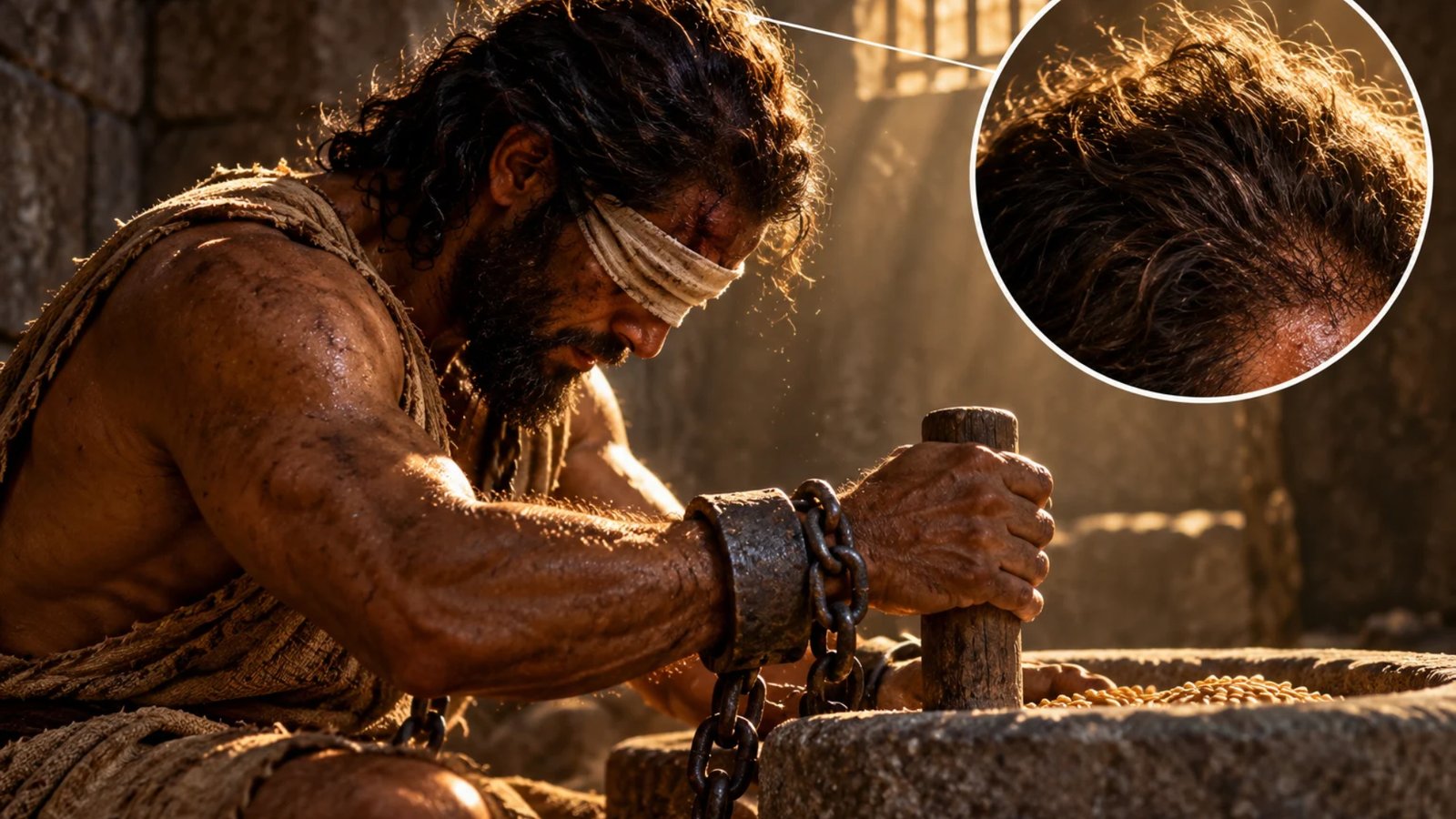
But the Hair on His Head Began to Grow Again
Judges 16:21–22 records one of the darkest moments in Samson’s life:
“Then the Philistines seized him, gouged out his eyes and took him down to Gaza. Binding him with bronze shackles, they set him to grinding grain in the prison. But the hair on his head began to grow again after it had been shaved.”
There is something striking about these two verses.
Verse 21 speaks of humiliation, captivity and loss.
Verse 22 begins with one small word:
“But.”
That word changes everything.
Samson had fallen. He had been betrayed by Delilah, captured by the Philistines, blinded, bound with bronze shackles and taken into prison. The man who once tore lions apart and defeated armies with supernatural strength was now reduced to grinding grain.
His eyes were gone.
His freedom was gone.
His reputation was gone.
His strength appeared to be gone.
But his story was not over.
“But the hair on his head began to grow again.”
The writer of Judges deliberately places this statement immediately after Samson’s humiliation. It is almost as if Scripture wants us to see something that Samson himself may not yet have understood:
God’s purposes had not completely ended with Samson’s failure.
The growing hair was not merely a physical detail. In the context of Samson’s Nazarite calling, his hair was connected to his consecration to God. From birth, Samson had been set apart.
His hair was not magical.
His strength was not in the hair itself.
His strength came from God.
But the growing hair represented something significant: what had been cut off was beginning to return.
This is where the passage speaks powerfully to anyone who has experienced failure.
Sometimes we think that because we have fallen, everything God intended for us has fallen with us.
We make a mistake and conclude that our purpose is finished.
We experience a moral failure and assume God can never use us again.
We lose an opportunity and believe our season has passed.
We experience humiliation and begin to identify ourselves with the prison rather than the calling.
But Samson’s story tells us to look again.
The prison was real, but it was not the end.
His eyes had been gouged out, but something else was growing.
His strength had disappeared, but something was returning.
His enemies thought they had finished him, but God was still writing.
This does not mean Samson’s choices had no consequences. They did.
Grace does not erase every consequence of disobedience. Samson had to live with what his decisions had produced. He was blind. He was imprisoned. He had been publicly humiliated.
But consequences are not always the same thing as abandonment.
You can experience the consequences of failure and still experience the mercy of God.
That is one of the mysteries of grace.
Samson had compromised his consecration, but God had not forgotten the calling that existed over his life.
The Philistines saw a defeated man.
God saw a story that was still unfolding.
There is something else remarkable about the imagery.
Samson was grinding grain.
The man who had once been a national deliverer was performing the work of a prisoner. His circumstances had become extremely ordinary and humiliating.
But perhaps this is where God began rebuilding him.
Before the final demonstration of his strength came another season of hiddenness.
Sometimes restoration begins quietly.
No announcement.
No applause.
No platform.
No crowd.
Just growth.
The hair was growing before Samson ever returned to the battlefield.
That is important.
We often want restoration to happen publicly. We want people to see that we have recovered. We want the platform restored, the opportunity restored, the influence restored.
But God may begin restoration in places nobody sees.
The first evidence that Samson’s story was changing was not a public victory.
It was hair growing in a prison.
There are things God may be rebuilding in you right now that nobody else can see.
Your prayer life.
Your discipline.
Your hunger for God.
Your character.
Your wisdom.
Your obedience.
Your faith.
The process may look insignificant, but growth is still growth even when it happens in prison.
Samson’s hair did not grow overnight.
The text says it “began to grow again.”
There was a process.
That is how restoration often works.
God can restore suddenly, but He also restores progressively.
A person may not look different immediately, but something has started.
Something is growing again.
Something that was lost is beginning to return.
Something that was dormant is beginning to awaken.
Something that was broken is beginning to heal.
Do not despise the beginning of restoration.
The Philistines were celebrating Samson’s defeat. They brought him out during their great celebration to mock him before their leaders.
They thought they were displaying the trophy of their victory.
But they did not realize that the man they had brought into the temple was no longer exactly the man they had captured.
Something had changed.
His hair had grown.
More importantly, Samson had begun to turn his attention back toward God.
His final prayer is revealing:
“Sovereign LORD, remember me. Please, God, strengthen me just once more…” — Judges 16:28
There is humility in that prayer.
Samson no longer speaks as though his strength belongs to him.
He asks God for strength.
And God answers.
The final moments of Samson’s life demonstrate that failure does not have to be the final chapter of a person’s story.
His ending was tragic, but it was also an act of deliverance against the Philistines.
Hebrews 11:32 even includes Samson among those remembered for faith.
That should make us pause.
Samson’s life contained tremendous failure, but Scripture did not erase him from the story of faith.
Your worst chapter does not necessarily become your final chapter.
There is a powerful lesson hidden in Judges 16:22.
The Philistines could shave Samson’s head.
They could imprison his body.
They could blind his eyes.
They could humiliate him.
But they could not determine the final outcome of his calling.
And perhaps that is the word someone needs today:
Something is growing again.
Your faith may have been weakened, but it can grow again.
Your passion may have diminished, but it can grow again.
Your discipline may have been broken, but it can grow again.
Your relationship with God may have suffered, but it can grow again.
You may have failed, but grace can begin again.
The evidence may currently be small.
It may look like Samson’s hair—barely noticeable.
But do not despise it.
Growth is evidence that the story is not over.
The God who called Samson was still present in the prison.
And the God who called you is not limited to the season in which you succeeded.
Sometimes God does His deepest restoration in hidden places.
Sometimes the first sign of a coming comeback is not a miracle that everyone can see.
Sometimes it is simply this:
the hair begins to grow again.
And when it does, do not ignore it.
Pray again.
Build again.
Seek God again.
Believe again.
Stand again.
Because failure may have interrupted the story, but it does not have to write the ending.
There is still growth after the shaving.
There is still purpose after the prison.
There is still grace after the fall.
And there can still be strength after the loss.
The hair began to grow again.
And so can you.










